Lesson date: 8/13/5856AA
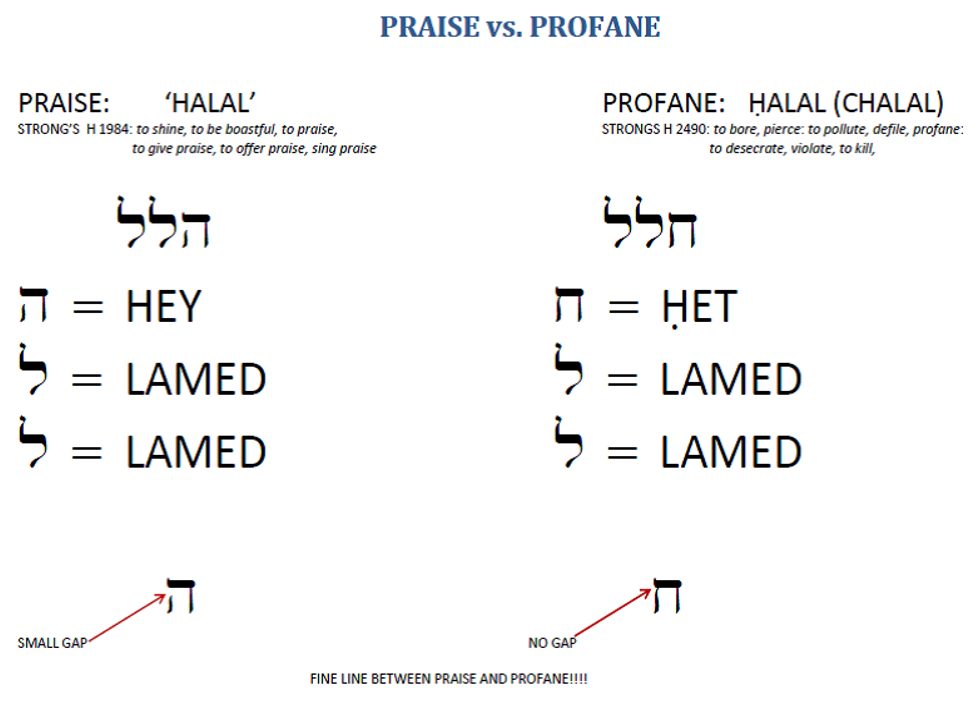
Verses 1-2 – I have used this illustration before and I use it again because I need to be reminded how slight, subtle the differences are between Praising YHVH’s Name and Profaning YHVH’s Name can be. It is very scary when you consider it. All the years that I spent going to “church” on Sunday thinking that I was “praising” His Name when, in reality, I was profaning His Name by not keeping His commands, His Shabbat.
Chapter 22 is a continuation of chapter 21 in which we are told how to be set apart so that we do not profane His Name: Lev 21:8 ‘And you shall set him apart, for he brings the bread of your Elohim, he is set-apart to you. For I, יהוה, setting you apart, am set-apart.
We have to be set apart in order to worship Him because, He is set apart. I didn’t get it. Not really.
Verses 3-8 – We see things that we are not supposed to do before worshipping our Father. They are simple commands and if we break them we are only unclean until dark, at the beginning of a new day.
Verse 9 – Here is my segue: Lev 22:9 ‘And they shall guard My Charge, lest they bear sin for it and die thereby, when they profane it. I יהוה set them apart.
This begs the question: what is His Charge? H4931 – משׁמרת – mishmereth – BDB Definition: 1) guard, charge, function, obligation, service, watch 1a) guard, watch, house of detention or confinement 1b) keeping, preserving 1c) charge, injunction 1d) office, function (ceremonial)
This has everything to do with the three idioms I mentioned to you but, first, let’s review. Why are we studying all of this over and over again? Lev 10:1 And Naḏaḇ and Aḇihu, the sons of Aharon, each took his fire holder and put fire in it, and put incense on it, and brought strange fire before יהוה, which He had not commanded them.
What was strange fire? Fire not taken from the bronze slaughter-place: Lev 6:12 ‘And the fire on the slaughter-place is kept burning on it, it is not put out. And the priest shall burn wood on it every morning, and arrange the ascending offering on it, and shall burn on it the fat of the peace offerings –
Lev 6:13 fire is continually kept burning on the slaughter-place, it is not put out.
If the fire is to be kept burning all night long that means there has to be a priest continually adding wood throughout the night. Right? Think of it this way, if the last offering of the day was at 3pm did everyone just lay down everything, punch the clock and go home? No! There were watches throughout the night: Psa_90:4 For a thousand years in Your eyes Are like yesterday that has past, Or like a watch in the night.
For all of you who were in the military, you know that there was always guard duty to pull 24/7 in boot camp. Who were you guarding the “dorm” from? The T.I. You had an “Access Control Roster” right by the door and you challenged anyone who came to the door and wanted in. If their name was not on the Access Control Roster you did not let them in for any reason unless authorized by someone on the roster. Confusing right? The T.I. “Training Instructor” who was the man or woman who was training you how to be a good recruit or “boot” was your worst enemy. He could come night or day but at night, you knew that he would show up. Why? To see if the guard was asleep. Let’s start putting this together.
Rev 16:15 “See, I am coming as a thief. Blessed is he who is staying awake and guarding his garments, lest he walk naked and they see his shame.”
Mat_24:42 “Watch therefore, for you do not know what hour your Master is coming.
Mat 24:43 “And know this, that if the master of the house had known what hour the thief would come, he would have watched and not allowed his house to be broken into.
The compound word for “master of the house” or as it says in the KJV “the goodman of the house” has a specific meaning: G3617 – οἰκοδεσπότης – oikodespotēs – oy-kod-es-pot’-ace From G3624 and G1203; the head of a family: – goodman (of the house), householder, master of the house.
G3624 – οἶκος – oikos – oy’-kos – Of uncertain affinity; a dwelling (more or less extensive, literally or figuratively); by implication a family (more or less related, literally or figuratively): – home, house (-hold), temple.
G1203 – δεσπότης – despotēs – des-pot’-ace – Perhaps from G1210 and πόσις posis (a husband); an absolute ruler (“despot”): – Lord, master.
The thief, i.e. High Priest, could come at any minute, like the T.I. And, check on the priest “keeping watch” and feeding the fire and, also eating the last of the last sacrifice. Just imagine, you are tired, you want to be home in bed with the wife, you have to keep feeding wood into the altar and you have to finish eating that breast of lamb that was given as the last offering. You know that if you have a full stomach and your tired there is a strong possiblity that you are going to sleep. Despite all of your training you fall asleep, afraid that the High Priest will come and catch you sleeping. No big deal, right? Wrong! Look at the second part of Rev. 16:15: “Guarding his garments”. If the High Priest caught the priest asleep he did not wake him up. He went over to the bronze altar and using the tongs took a live coal from the fire and dropped it on the outer garment of the sleeping priest. The priest’s clothes would then catch fire and, hopefully awaken the sleeping priest, who then would have to jump up in fear, tear off his clothes and run home naked. With the priest screaming at the top of his lungs everyone would come to the flap of their tent to see what was happening and would see the shame of the priest.
Mar 13:33 “Take heed, watch and pray, for you do not know when the time is –
Mar 13:34 as a man going abroad, having left his house and given authority to his servants, and to each his work, and commanded the doorkeeper to watch.
Mar 13:35 “Watch therefore, for you do not know when the master of the house is coming – in the evening or at midnight, or at the crowing of the cock, or in the morning,
Mar 13:36 lest, coming suddenly, he should find you sleeping.
Mar 13:37 “And what I say to you, I say to all: Watch!”
Yeshua is our High Priest, our example or T.I.: Joh_14:15 “If you love Me, you shall guard My commands.
Joh 14:21 “He who possesses My commands and guards them, it is he who loves Me. And he who loves Me shall be loved by My Father, and I shall love him and manifest Myself to him.”
Joh 14:23 יהושע answered him, “If anyone loves Me, he shall guard My Word. And My Father shall love him, and We shall come to him and make Our stay with him.
Joh 14:24 “He who does not love Me does not guard My Words. And the Word which you hear is not Mine but of the Father Who sent Me.
We are commanded to be set-apart because He is set-apart and to do that we must guard His Commands. Now we know why we need to read the “training manual” over and over. We need to be more proficient. We must know our weaknesses so that we can improve them and be found acceptable to our High Priest.
- The thief – High Priest
- Master or Goodman of the House – us
- Guarding his garments – don’t fall asleep in the Word
Now, let’s look at something else that seems out of place: Mat 25:35 for I was hungry and you gave Me food, I was thirsty and you gave Me drink, I was a stranger and you took Me in,
Mat 25:36 was naked and you clothed Me, I was sick and you visited Me, I was in prison and you came to Me.’
Hungry – for the Word
Thirsty – for the mayyim chayyim (like the woman at the well)
Stranger – to the Kingdom of Elohim (not of Yisra’el)
Naked – because I fell asleep and everyone saw my nakedness as I ran out of the Hekal
Sick – I was malnourished (eating the king’s food not the Bread of Life or the Blood of the Lamb)
Prison – held in bondage in Mitsrayim
Once again, here is a beautiful segue: Lev 22:10 ‘And no stranger eats the set-apart offering. A sojourner with the priest, or a hired servant, does not eat the set-apart offering.
Lev 22:11 ‘But when the priest buys a being with his silver, he does eat of it. And one who is born in his house does eat his food.
We are forbidden from eating of the set-apart offering. It is only for the set-apart unless, we have been purchased by the priest with silver. Have we? Mat_26:15 and said, “What would you give me to deliver Him to you?” And they counted out to him thirty pieces of silver.
Mat_27:3 Then Yehuḏah – he who delivered Him up – having seen that He had been condemned, repented, returned the thirty pieces of silver to the chief priests and to the elders,
Mat_27:9 Then was filled what was spoken by Yirmeyahu the prophet, saying, “And they took the thirty pieces of silver, the price of Him who was pierced, on whom they of the children of Yisra’ěl set a price,
That 30 pieces of silver was our “bride price” that had to be paid in order that we could be redeemed out of Mitsrayim by our High Priest.
Ahavah,
Lesson date: 03/23/5860AA
Verses 1-2 – All the years that I spent going to “church” on Sunday thinking that I was “praising” His Name when, in reality, I was profaning His Name by not keeping His commands, His Shabbat. Not only was I not keeping His Shabbat but I was not using His Name and had broke His command: Exo 20:7 “You do not bring the Name of יהוה your Elohim to naught, for יהוה does not leave the one unpunished who brings His Name to naught. <<<naught – Noun 1. archaic. 2. nothing or nothingness; ruin or failure – a variant spelling (esp US) of nought
Chapter 22 is a continuation of chapter 21 in which the priests are told how to be set apart so that we do not profane His Name: Lev 21:8 ‘And you shall set him apart, for he brings the bread of your Elohim, he is set-apart to you. For I, יהוה, setting you apart, am set-apart.
If it is for the priests then why are we studying it? Just a reminder from last week: 1Pe 2:9 But you are a chosen race, a royal priesthood, a set-apart nation, a people for a possession, that you should proclaim the praises of Him who called you out of darkness into His marvellous light,
We have to be set apart in order to worship Him because, He is set apart. I didn’t get it. Not really.
Verses 3-8 – We see things that we are not supposed to do before worshipping our Father. They are simple commands and if we break them we are only unclean until dark, at the beginning of a new day.
Verse 9 – Here is my segue: Lev 22:9 ‘And they shall guard My Charge, lest they bear sin for it and die thereby, when they profane it. I יהוה set them apart.
This begs the question: what is His Charge? H4931 – משׁמרת – mishmereth – BDB Definition: 1) guard, charge, function, obligation, service, watch 1a) guard, watch, house of detention or confinement 1b) keeping, preserving 1c) charge, injunction 1d) office, function (ceremonial)
This has everything to do with the three idioms I mentioned to you but, first, let’s review. Why are we studying all of this over and over again? Lev 10:1 And Naḏaḇ and Aḇihu, the sons of Aharon, each took his fire holder and put fire in it, and put incense on it, and brought strange fire before יהוה, which He had not commanded them.
What was strange fire? Fire not taken from the bronze slaughter-place: Lev 6:12 ‘And the fire on the slaughter-place is kept burning on it, it is not put out. And the priest shall burn wood on it every morning, and arrange the ascending offering on it, and shall burn on it the fat of the peace offerings –
Lev 6:13 fire is continually kept burning on the slaughter-place, it is not put out.
If the fire is to be kept burning all night long that means there has to be a priest continually adding wood throughout the night. Right? Think of it this way, if the last offering of the day was at approximately 3pm did everyone just lay down everything, punch the clock and go home? No! There were watches throughout the night: Psa_90:4 For a thousand years in Your eyes Are like yesterday that has past, Or like a watch in the night.
For all of you who were in the military, you know that there was always guard duty to pull 24/7 in boot camp. Who were you guarding the “dorm” from? The T.I. posted an “Access Control Roster” right by the door and you challenged anyone who came to the door and wanted in. If their name was not on the Access Control Roster you did not let them in for any reason unless authorized by someone on the roster. Confusing right? The T.I. “Training Instructor” who was the man or woman who was training you how to be a good recruit or “boot” was your worst enemy. He could come night or day but at night, you knew that he would show up. Why? To see if the guard was asleep. Let’s start putting this together.
Rev 16:15 “See, I am coming as a thief. Blessed is he who is staying awake and guarding his garments, lest he walk naked and they see his shame.”
Mat_24:42 “Watch therefore, for you do not know what hour your Master is coming.
Mat 24:43 “And know this, that if the master of the house had known what hour the thief would come, he would have watched and not allowed his house to be broken into.
The compound word for “master of the house” or as it says in the KJV “the goodman of the house” has a specific meaning: G3617 – οἰκοδεσπότης – oikodespotēs – oy-kod-es-pot’-ace From G3624 and G1203; the head of a family: – goodman (of the house), householder, master of the house.
G3624 – οἶκος – oikos – oy’-kos – Of uncertain affinity; a dwelling (more or less extensive, literally or figuratively); by implication a family (more or less related, literally or figuratively): – home, house (-hold), temple.
G1203 – δεσπότης – despotēs – des-pot’-ace – Perhaps from G1210 and πόσις posis (a husband); an absolute ruler (“despot”): – Lord, master.
The thief, i.e. High Priest, could come at any minute, like the T.I. And, check on the priest(s) “keeping watch” and feeding the fire and, also eating the last of the last sacrifice. Just imagine, you are tired, you want to be home in bed with the wife, you have to keep feeding wood into the altar and you have to finish eating that breast of lamb that was given as the last offering. You know that if you have a full stomach and you are tired there is a strong possiblity that you are going to sleep. Despite all of your training you fall asleep, afraid that the High Priest will come and catch you sleeping. No big deal, right? Wrong! Look at the second part of Rev. 16:15: “Guarding his garments”. If the High Priest caught the priest asleep he did not wake him up. He went over to the bronze altar and using the tongs took a live coal from the fire and dropped it on the outer garment of the sleeping priest. The priest’s clothes would then catch fire and, hopefully awaken the sleeping priest, who then would have to jump up in fear, tear off his clothes and run home naked. With the priest screaming at the top of his lungs everyone would come to the flap of their tent to see what was happening and would see the shame of the priest.
Mar 13:33 “Take heed, watch and pray, for you do not know when the time is –
Mar 13:34 as a man going abroad, having left his house and given authority to his servants, and to each his work, and commanded the doorkeeper to watch.
Mar 13:35 “Watch therefore, for you do not know when the master of the house is coming – in the evening or at midnight, or at the crowing of the cock, or in the morning,
Mar 13:36 lest, coming suddenly, he should find you sleeping.
Mar 13:37 “And what I say to you, I say to all: Watch!”
Yeshua is our High Priest, our example or T.I.: Joh_14:15 “If you love Me, you shall guard My commands.
Joh 14:21 “He who possesses My commands and guards them, it is he who loves Me. And he who loves Me shall be loved by My Father, and I shall love him and manifest Myself to him.”
Joh 14:23 יהושע answered him, “If anyone loves Me, he shall guard My Word. And My Father shall love him, and We shall come to him and make Our stay with him.
Joh 14:24 “He who does not love Me does not guard My Words. And the Word which you hear is not Mine but of the Father Who sent Me.
We are commanded to be set-apart because He is set-apart and to do that we must guard His Commands. Now we know why we need to read the “training manual” over and over. We need to be more proficient. We must know our weaknesses so that we can improve them and be found acceptable to our High Priest.
- The thief – High Priest
- Master or Goodman of the House – our charge is to guard His House (1Cor. 3:16)
- Guarding his garments – don’t fall asleep in the Word
Now, let’s look at something else that seems out of place: Mat 25:35 for I was hungry and you gave Me food, I was thirsty and you gave Me drink, I was a stranger and you took Me in,
Mat 25:36 was naked and you clothed Me, I was sick and you visited Me, I was in prison and you came to Me.’
Hungry – for the Word
Thirsty – for the mayyim chayyim (like the woman at the well)
Stranger – to the Kingdom of Elohim (not of Yisra’el)
Naked – because I fell asleep and everyone saw my nakedness as I ran out of the Hekal
Sick – I was malnourished (eating the king’s food not the Bread of Life or the Blood of the Lamb)
Prison – still held in bondage in Mitsrayim
Once again, here is a beautiful parallel: Lev 22:10 ‘And no stranger eats the set-apart offering. A sojourner with the priest, or a hired servant, does not eat the set-apart offering.
Lev 22:11 ‘But when the priest buys a being with his silver, he does eat of it. And one who is born in his house does eat his food.
We are forbidden from eating of the set-apart offering. It is only for the set-apart unless, we have been purchased by the priest with silver. Have we? Mat_26:15 and said, “What would you give me to deliver Him to you?” And they counted out to him thirty pieces of silver.
Mat_27:3 Then Yehuḏah – he who delivered Him up – having seen that He had been condemned, repented, returned the thirty pieces of silver to the chief priests and to the elders,
Mat_27:9 Then was filled what was spoken by Yirmeyahu the prophet, saying, “And they took the thirty pieces of silver, the price of Him who was pierced, on whom they of the children of Yisra’ěl set a price,
That 30 pieces of silver was our “bride price” that had to be paid in order that we could be redeemed out of Mitsrayim by our High Priest. As I have stated before, Yeshu’a is our Kinsman Redeemer.
Not only is silver indicative of our redemption but it represents the purity of the Word: Psa 12:6 The Words of יהוה are clean Words, Silver tried in a furnace of earth, Refined seven times.
Yeshu’a is absolutely the pure Word of Elohim that has been fully tested and tried and found to be True.
Ahavah vberakhot,
 CahalTx