Lesson date: 03/16/5860AA
Lev_19:2 “Speak to all the congregation of the children of Yisra’ěl, and say to them, ‘Be set-apart, for I יהוה your Elohim am set-apart.
This is not a suggestion, it’s not an exhortation or a request. It is a Command. I can already see those little wheels turning, “But it is just for the priesthood, right?” 1Pe 2:9 But you are a chosen race, a royal priesthood, a set-apart nation, a people for a possession, that you should proclaim the praises of Him who called you out of darkness into His marvellous light,
1Pe 2:10 who once were not a people, but now the people of Elohim; who had not obtained compassion, but now obtained compassion.
Well, obviously Kepha was writing to the Jews in Yerushalyim, right? Wrong:
1Pe 1:1 Kěpha, an emissary of יהושע Messiah, to the chosen, strangers of the dispersion in Pontos, Galatia, Kappadokia, Asia, and Bithunia,
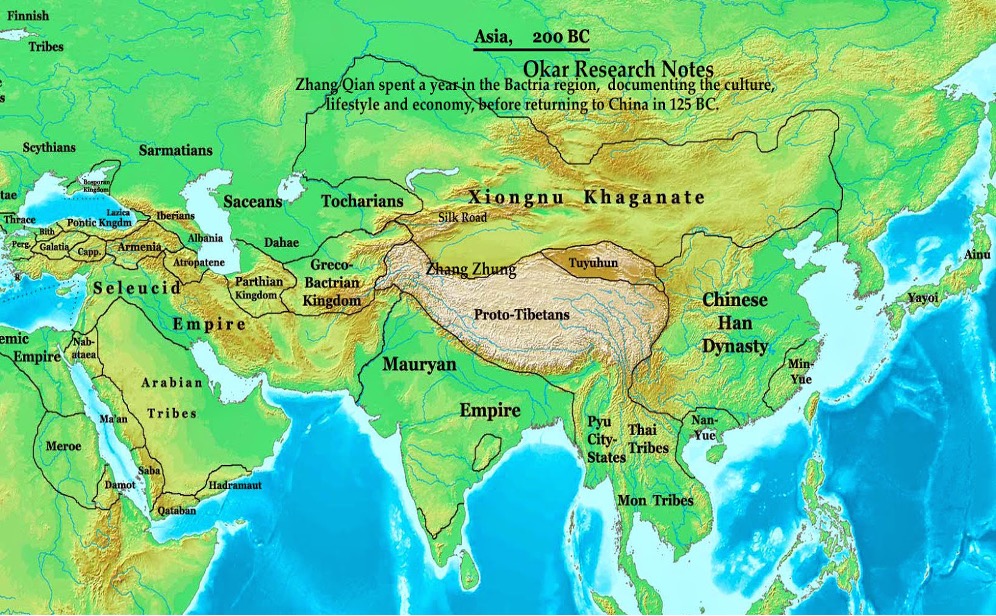
Look at the map above, these are the peoples of the countries above. From modern day Egypt, Lebanon, Israel, Jordan, Turkey all the way to modern China. Notice the name of China: Han Dynasty, These are the former Israelites who escaped from their Assyrian masters and fled to what is now China and became the ancestors of modern China. ((For context, see study Freeing the Slaves.)) This is the ancient Asia that Kepha is writing about.
Verse 1 – “Do not defile yourself for the dead.” This is very difficult, believe me. You want to commemorate the occasion some kind of way. Remember, Aharon lost two sons and was told to not to make an outward sign of grief but the people themselves could grieve. (Lev. 10)
Verses 2-3 – We see an exception because those people were probably living in the same tent as the priest and for those who were closest to the priest he could be defiled but Aharon was commanded not to go outside of the Tent because he already had the Anointing Oil upon him and if he went it outside of the Tent of Appointment with the oil upon him, he would die.(Lev. 10)
Mat 28:6 “He is not here, for He was raised, as He said. Come, see the place where the Master lay.
Mat 28:7 “And go quickly, say to His taught ones that He was raised from the dead, and see, He is going before you to Galil. There you shall see Him. See, I have told you.”
Mat 28:8 And they left the tomb quickly, with fear and great joy, and ran to report to His taught ones.
Mar 16:5 And having entered into the tomb, they saw a young man sitting on the right, wearing a white robe, and they were greatly astonished.
They had gone inside the tomb and were therefore defiled.
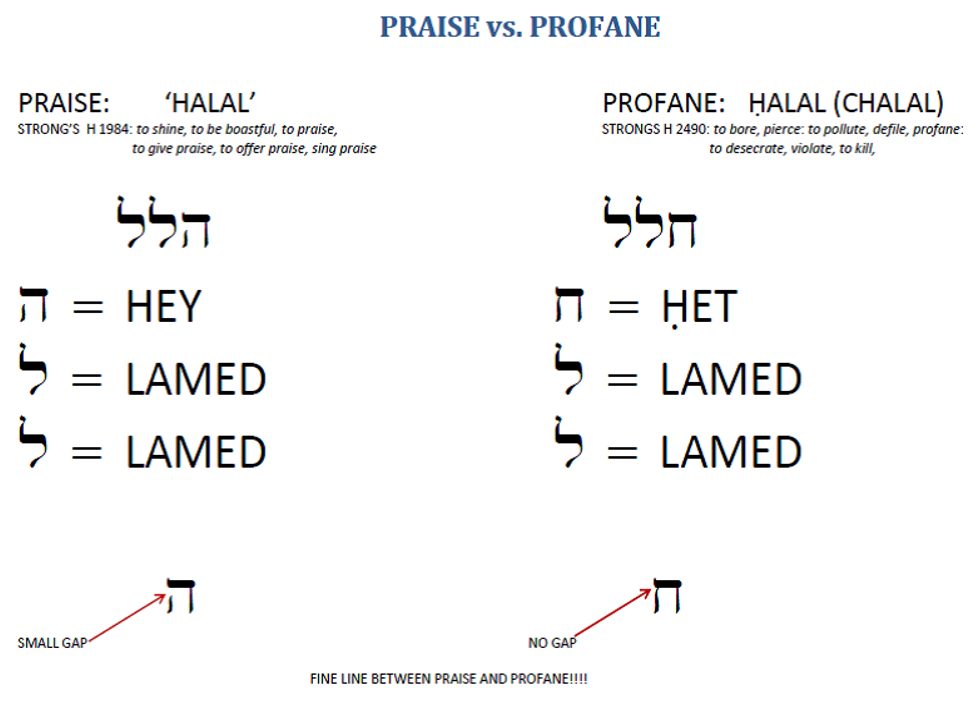
Verses 4-5 – A leader does not defile themselves. It is not just for the priests but we are told to be a “Royal Priesthood”. Once again, here is the fine line that we walk between to “praise Yah” and to “profane Yah”:
The difference is the small gap. What does the gap represent?
Verses 6-7 – Restriction on who the wife of a priest can and cannot be.
Verse 8 – Once again the command to be set-apart because YHVH is set-apart.
Verse 9 – If the priest’s daughter whores she is profaning her father and herself.
Verse 10 – Does not unbind his head or tear his garments:
Mat 26:65 Then the high priest tore his garments, saying, “He has blasphemed! Why do we need any more witnesses? See, now you have heard His blasphemy!
If the Yehudim were truly keeping Torah then right here Caiphas’ authority as high priest just ended because he tore his garments.
Look very closely at the first part of Verse 10, unbinding the head. This does not only refer to taking off the turban but also failing to restrain the people: Exo 32:25 And Mosheh saw that the people were let loose, for Aharon had let them loose, to their shame among their enemies.
Aharon had not restrained the people.
Verse 11 – Not to defile yourself for father or mother: Mat 8:21 And another of His taught ones said to Him, “Master, first let me go and bury my father.”
Mat 8:22 But יהושע said to him, “Follow Me, and leave the dead to bury their own dead.”
There is much going on here in these 2 verses: first if his father was already dead why is he now following Yeshu’a?; who are the dead?
It the tense that it is expressed this taught one is asking permission to go home and wait for his father to die and perhaps, receive an inheritance before he leaves. How long before his father dies? Hours, days, weeks, months years, no one knows but he wants to come back when it is convenient for him and after he has received his inheritance.
In the ancient world a body was buried immediately. Even in Egypt, where they practiced embalming, the body would begin to deteriorate immediately in the warm climate: Joh 11:39 יהושע said, “Take away the stone.” Martha, the sister of him who had died, said to Him, “Master, already he smells, for it is four days.”
This puts the proper context on the “dead” father.
Who are the dead? Those that did the work of the graveyard. They were already ceremonially unclean and so being around a dead body did not affect their worship. This would have included lepers, a woman who had an issue of blood that would not stop, a eunuch, etc. They were referred to in this era as the dead.
Verse 12 – If you have already been set-apart by having the anointing oil on your head you cannot leave your posts until your watch is complete.
Verses 13-14 – Restriction on who the priests could marry.
Verses 15-23 – This deals with the offspring of the priests. Any son with a defect may not bring the bread near to the Set-apart place, nor go to the altar to receive the offering but they are allowed to eat the set-apart bread but cannot function as a priest.
Ahavah vberakhot,
 CahalTx