Lesson date: 3/27/5856AA
39:1-31 – Priestly Garments:

Does this person look different?
1 – The Breastplate:
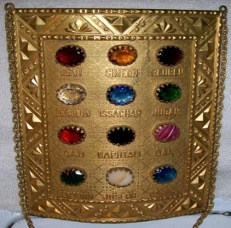
חשֶּן ḥoshen – Strong’s H2833 – ‘breastplate, breast-piece, pouch’ and it was made of gold, of blue and purple and scarlet material, and fine woven linen. It held the stones bearing the names of the Yisra’ĕlites safely in place and also carried the urim and tummim.
2 – The Shoulder garment:
אֵפוֹד ephoḏ – Strong’s H646 – ‘outer garment of priest’. This was the ‘outer garment worn by the priests that was white, however the High Priests ephod was more costly – woven of gold, blue, purple, scarlet, and linen threads.
3 – A Robe:
מְעִיל meil – Strong’s H4598 – ‘robe, mantle, cloak, i.e., an exterior garment which covers an inner tunic; and can also be described as a ‘sleeveless coat’’.
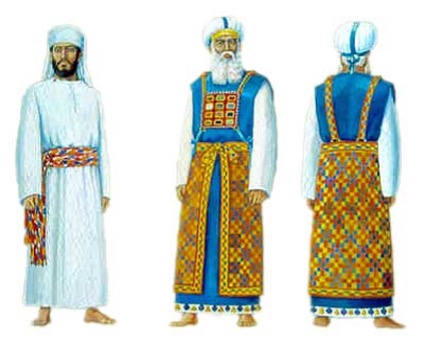
4 – An Embroidered long shirt:
וּכְתֹנֶּת תְַּשְבֵץ – ‘vakathoneth tashbets’ – כְתֹנֶּת kethoneth – Strong’s H3801 – ‘a tunic, garment, clothing as a covering more complete than a loincloth, a basic garment reaching the knees’ and תַשְבֵץ
tashbets – Strong’s H8665 – ‘checkered work, special woven fabric, i.e., a decorative fabric special either because of the variegated pattern of the weaving, or the special threads (silver or gold?) that would be interwoven with it’.
5 – A Turban:
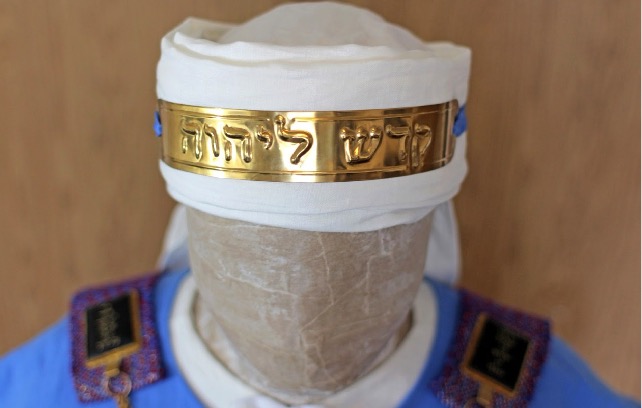
מִצְנֶּפֶּת mitsnepheth – Strong’s H4701 – ‘turban, head-wrap, headband, i.e., an ornamental headdress cap made by wrapping cloth around and around on the head’ and comes from the root word – צָּנַף tsanaph – Strong’s H6801 which means ‘to wrap, wind up together, roll you tightly’.
6 – A Girdle:
אַבְנֵט aḇnet – Strong’s H73 – ‘girdle/sash worn around the waist.
Verses 1-2 – “To do service” – H8334 – שׁרת – shârath – BDB Definition: 1) (Piel) to minister, serve, minister to: Mar 10:42 And יהושע, calling them near, said to them, “You know that those who think to rule the nations are masters over them, and their great ones exercise authority over them.
Mar 10:43 “But it is not so among you, but whoever wishes to become great among you shall be your servant.
Mar 10:44 “And whoever wishes to be first among you, shall be servant of all.
Mar 10:45 “For even the Son of Aḏam did not come to be served, but to serve, and to give His life a ransom for many.”
Verse 3 – “The work of a skilled workman” – 2Ti 2:15 Do your utmost to present yourself approved to Elohim, a worker who does not need to be ashamed, rightly handling the Word of Truth.
Eph 2:10 For we are His workmanship, created in Messiah יהושע unto good works, which Elohim prepared beforehand that we should walk in them.
Verse 6 – “Two shoham stones”. We see in many translation that shoham = onyx. I do not believe this. Working backword in tracing the true meanng of shoham I found that it is indicative of Lapis lazuli. One picture of the 2 stones actually named them as lapis lazuli.
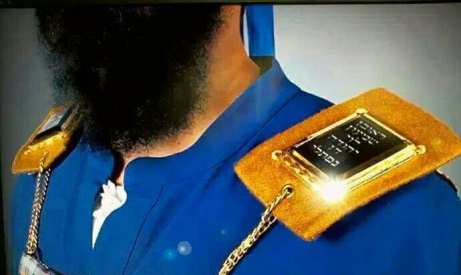
Notice anything unusual about lapis?
Verses 16-20 – We see “two” thirteen times. Thirteen represents “rebellion and lawlessness”. It is also represents Nimrod, who was the 13th in Ham’s line. Nimrod tried to challenge YHVH’s authority. Thirteen also represents the number of man’s governments or kingdoms. Thirteen is in direct opposition to YHVH who is “echad” = One. Look at echad in Hebrew: H259 – אחד – ‘echâd : Aleph = (1) Het = (8) and Dalet = (4) 1+8+4 = 13
Verse 21 – This verse makes it plain that the breast-piece would not come loose because it was tied with a blue cord – Torah!
Verses 24-25 – Pomegranates and bells. Pomegranates represent many things in Scripture: Abraham; The Word (sown by the Farmer in expectation of a harvest); fruitfullness. The bells can be a substitute for a trumpet or shophar. When the final shophar sounds will there be a harvest? Luk 18:8 “I say to you that He shall do right to them speedily. But when the Son of Aḏam comes, shall He find the belief on the earth?”
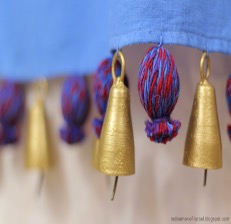
Bell = H6472 – pa’amon and comes from H6471 – pa’am – step, beat, foot + step. It represents walking in a pattern of behaviour or life.
Verses 30-31 – Plate = H6731 – צץ / ציץ – tsı̂yts / tsits – BDB Definition: 1) flower, bloom 1a) flower, bloom. Does this word look familiar?
The plate that is marked “Set-Apart to YHVH” is held on by a blue cord. We can only be set-apart to YHVH by Torah!
2Co 7:1 Having, then, these promises, beloved, let us cleanse ourselves from all defilement of the flesh and spirit, perfecting set-apartness in the fear of Elohim.
1Th 4:3 For this is the desire of Elohim: your set-apartness! – that you should abstain from whoring,
1Th 4:4 that each one of you should know how to possess his own vessel in set-apartness and respect,
1Th 4:5 not in passion of lust, like the nations who do not know Elohim,
1Th 4:6 not to overstep and take advantage of his brother in this matter, because the Master is the revenger of all such, as we indeed said to you before and earnestly warned.
1Th 4:7 For Elohim did not call us to uncleanness, but in set-apartness.
Mar 3:35 “For whoever does the desire of Elohim is My brother and My sister and mother.”
Verse 43 – “They did it as YHVH had commanded: Mat 6:9 “This, then, is the way you should pray: ‘Our Father who is in the heavens, let Your Name be set-apart,
Mat 6:10 let Your reign come, let Your desire be done on earth as it is in heaven.
 CahalTx