Lesson date: 1/10/5856AA
I will borrow the image from the study guide of last week to show the approximate placement of the bronze slaughter place within the courtyard
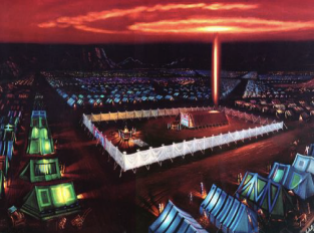
Just to the left, facing the slaughter place or altar in the painting would be the gate/entrance into the courtyard.
Verses 1-8 – As I have mentioned before, and this is my opinion, not established fact, I believe that Mosheh used the measure of the “royal” cubit a/k/a the “extended” cubit in the construction of the dwelling place and everything associated with it. Why? The royal cubit was the primary measure in Egypt and with Mosheh’s training in the royal court and also military he would have been more familiar with the use of the royal cubit. I believe that it fell out use after Mosheh and Yehoshua’s deaths and the Children of Yisra’el began using the shorter or standard cubit afterward. The resulting difference in length and width of the cubit would total 8.5 feet rather than 7.5 feet and its height would have been 5.1 feet rather than 4.5 feet. Also, I believe that the use of the royal cubit was so unfamiliar to the Children of Yisra’el by Ezekiel’s time that YHVH had to specify its length in Ezekiel 40:5 & 43:13.
Can you think of any reason for construction to be out of acacia wood and then overlaying the wood with bronze rather than making it of solid bronze? Why use bronze in its construction at all? Why not use gold or silver?
We see once again that YHVH reminds Mosheh that he is to build the altar just like the one he was shown while on the mountain. Once more, it is my opinion that YHVH opened the window into heaven and Mosheh saw the heavenly original so that he could build the earthly copy.
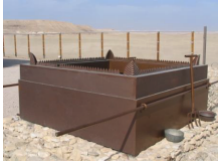
In the photo above you can clearly see the horns on each of the four corners. Horns represent strength and power and will be in the psyche of the Hebrew forever: Psa_18:2 יהוה is my rock and my stronghold and my deliverer; My Ěl is my rock, I take refuge in Him; My shield and the horn of my deliverance, my high tower.
Luk 1:68 “Blessed be יהוה Elohim of Yisra’ěl, for He did look upon and worked redemption for His people,
Luk 1:69 and has raised up a horn of deliverance for us in the house of His servant Dawiḏ,
Some people would ask “why have an altar or slaughter place at all? Lev 17:11 ‘For the life of the flesh is in the blood, and I have given it to you upon the slaughter-place to make atonement for your lives, for it is the blood that makes atonement for the life.’
Heb 9:22 And, according to the Torah, almost all is cleansed with blood, and without shedding of blood there is no forgiveness.
Using the allusion to the horn of deliverance and that all is cleansed by blood it is important to note that at the commencement of sacrificing that the blood was saved from the sacrifice and then the High Priest would sprinkle or pour some of the blood on each of the four horns showing that the blood had the power to atone for sin. Heb_2:17 So in every way He had to be made like His brothers, in order to become a compassionate and trustworthy High Priest in matters related to Elohim, to make atonement for the sins of the people.
We now have an idea what part or aspect of Yeshua’s life the altar represent: Isa 53:7 He was oppressed and He was afflicted, but He did not open His mouth. He was led as a lamb to the slaughter, and as a sheep before its shearers is silent, but He did not open His mouth.
Heb 9:13 For if the blood of bulls and goats and the ashes of a heifer, sprinkling the defiled, sets apart for the cleansing of the flesh,
Heb 9:14 how much more shall the blood of the Messiah, who through the everlasting Spirit offered Himself unblemished to Elohim, cleanse your conscience from dead works to serve the living Elohim?
Verses 4-5 – The grating that was constructed about halfway between the top and the bottom. The fire would consume the flesh and the grating would stop the bones from falling through. Even this would provide a picture or foreshadowing of a redemptive work by YHVH: Amo 9:9 “For look, I am commanding, and I shall sift the house of Yisra’ěl among all the nations, as one sifts with a sieve, yet not a grain falls to the ground.
Verses 9-18 – The courtyard and the gate. The courtyard is 100 (10×10) cubits long and 50 (5×10) cubits wide. Ten is one of the numbers that represent completeness 3, 7, 10 & 12 each in their own way draws our attention to something being complete. The number 10 is focusing our attention to the completeness of order built upon laws, i.e. the Ten Words, proving once again that Creation is not a random act of a Big Bang but by the Spoken Word of Elohim. And, as we have mentioned before 50 is 5 x 10 = Grace x Completeness. Fifty also represents the Ruach Hakodesh in that the Ruach was given to the people on Shavuoth or the 50th day of counting the Omer, which the Greeks did not understand so they just called it 50 or Pentecost.
What other significance is there in 10? (Clue: think days in a month)
We see that the courtyard was about 170 feet long and 85 feet wide.
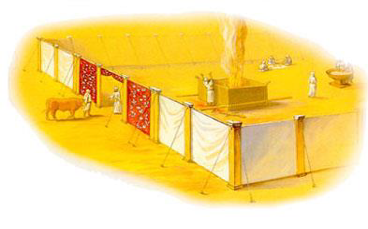
At one end of the courtyard is the gate. This would be the gate that you and I, had we been there, would bring our offering to. At the gate we would be met by a priest and led inside before the altar. Here, we would place our hand on the forehead of the innocent animal and slice its throat. The priest would then catch the blood to be used in placing some on the four horns of the altar. The priest would then take the slaughter offering and place it on the grate. The ordinary Yisra’elite would go no farther in than just inside the gate.
The gate itself is 20 cubits or about 34 feet wide and on either side were screens of 15 cubits each for a total of 50 cubits. The gate was composed of scarlet, blue and purple fine woven material. Imagine walking through the desert and topping a knoll and looking down on the camp of the Children of Yisra’el. You would see thousand of ordinary tents, most made of skins of animals and were probably tan, brown, black or dull gray in color depending on the type of animal skin used. Then in the center of the camp you would see this 170 feet long, 85 feet wide and 10 feet high white curtain, woven from fine linen, and at one end you could not help but to see the bright scarlet, blue and purple gate. The gate would be the most beautiful sight in the otherwise drab and dreary encampment.
Joh 10:7 יהושע therefore said to them again, “Truly, truly, I say to you, I am the door of the sheep.
Joh 10:8 “All who came before Me are thieves and robbers, but the sheep did not hear them.
Joh 10:9 “I am the door. Whoever enters through Me, he shall be saved, and shall go in and shall go out and find pasture.
What is the significance of the Dwelling Place, courtyard and gate for us today?
Verses 19-21 – Notice that all the utensils were constructed of bronze, even the tent pegs: Isa 22:22 And I shall place the key of the house of Dawiḏ on his shoulder. And he shall open, and no one shuts; and shall shut, and no one opens.
Isa 22:23 And I shall fasten him like a peg in a steadfast place, and he shall become a throne of esteem to his father’s house.
Zec 10:4 “From him comes the corner-stone, from him the tent peg, from him the battle bow, from him every ruler, together.
Rev 3:12 “He who overcomes, I shall make him a supporting post in the Dwelling Place of My Elohim, and he shall by no means go out. And I shall write on him the Name of My Elohim and the name of the city of My Elohim, the renewed Yerushalayim, which comes down out of the heaven from My Elohim, and My renewed Name.
Do you see how key the Dwelling Place, the fence, the courtyard, the gate, the posts and columns and, even the tent pegs were so deeply ingrained into the mind and hearts of the Yisra’elites that if we are not familiar with them and their function we miss the beauty in the Word.
Last but, definitely not least, is the oil. Oil is synonymous with light, without oil there is no light. What else does oil represent? What makes oil so important in the following Scripture?
Mat 25:1 “Then the reign of the heavens shall be compared to ten maidens who took their lamps and went out to meet the bridegroom.
Mat 25:2 “And five of them were wise, and five foolish.
Mat 25:3 “Those who were foolish, having taken their lamps, took no oil with them,
Mat 25:4 but the wise took oil in their containers with their lamps.
Mat 25:5 “Now while the bridegroom took time, they all slumbered and slept.
Mat 25:6 “And at midnight a cry was heard, ‘See, the bridegroom is coming, go out to meet him!’
Mat 25:7 “Then all those maidens rose up and trimmed their lamps.
Mat 25:8 “And the foolish said to the wise, ‘Give us of your oil, because our lamps are going out.’
Mat 25:9 “But the wise answered, saying, ‘No, indeed, there would not be enough for us and you. Instead, go to those who sell, and buy for yourselves.’
Mat 25:10 “And while they went to buy, the bridegroom came, and those who were ready went in with him to the wedding feast, and the door was shut.
Mat 25:11 “And later the other maidens also came, saying, ‘Master, Master, open up for us!’
Mat 25:12 “But he answering, said, ‘Truly, I say to you, I do not know you.’
Mat 25:13 “Watch therefore, because you do not know the day nor the hour in which the Son of Aḏam is coming,
Or, what about here: Rev 11:3 “And I shall give unto my two witnesses, and they shall prophesy one thousand two hundred and sixty days, clad in sackcloth.”
Rev 11:4 These are the two olive trees and the two lampstands that are standing before the Elohim of the earth.
Zec 4:2 And he said to me, “What do you see?” So I said, “I have looked, and see: a lampstand all of gold with a bowl on top of it, and on the stand seven lamps with seven spouts to the seven lamps.
Zec 4:3 “And two olive trees are by it, one at the right of the bowl and the other at its left.”
To truly understand prophecy and its fulfillment we must understand the context in which it is written:
Isa 46:9 “Remember the former events of old, for I am Ěl, and there is no one else – Elohim, and there is no one like Me,
Isa 46:10 declaring the end from the beginning, and from of old that which has not yet been done, saying, ‘My counsel does stand, and all My delight I do,’
When people think about prophecy they think Revelation, Ezekiel, Daniel, Isaiah, etc. When instead, they should be thinking Bereshith, Shemoth, Wayyiqra, Bemidbar and Debarim.
 CahalTx