Lesson date: 11/06/5855AA
Verse 1 – Yithro = Re’uel =Mosheh’s father-in-law. There are 27 verses in Chapter 18 and the term father-in-law is mentioned thirteen times. Maybe this is trying to tell us something.
What do we know about Re’uel? He is the priest of Midyan and his name means “friend of El” (H7467). The term for father-in-law literally means “To give a daughter away” or “wife’s father”. Yithro taught Mosheh about sheep herding, Mosheh, upon seeing the burning bush, requested permission of Yithro to go back to Mitsrayim to get his brethren out of slavery. Consider the fact that at 80 years of age Mosheh could have been twice his father-in-law’s age and after herding sheep for 40 years Mosheh is now herding the sheep of Yisra’el for YHVH.
Midyan was the son of Abraham and Qeturah: Gen 25:1 And Aḇraham took another wife, whose name was Qeturah.
Gen 25:2 And she bore him Zimran, and Yoqshan, and Meḏan, and Miḏyan, and Yishbaq, and Shuwaḥ.
Yithro was probably about 6 generations removed from Abraham but was still a kinsman of Mosheh, just not a descendant of Yisra’el. Midyan settled in what is today northwestern Saudi Arabia.
Please forgive me for moving away from Hebrew just a moment so that I can explain how fantastic Yah’s Word really is and to do this I will explain some Semitic customs. As an “Arab”, not Muslim, Yithro has different customs than Mosheh, who is a Levite. For an Yisra’elite circumcision took place on the eighth day after birth. For an “Arab” circumcision took place prior to marriage hence Gereshom going uncircumcised: Exo 4:24 And it came to be on the way, in the lodging place, that יהוה met him and sought to kill him.
Exo 4:25 And Tsipporah took a sharp stone and cut off the foreskin of her son and threw it at his feet, and said, “You are indeed a bridegroom of blood to me!”
Exo 4:26 So He let him go. Then she said, “You are a bridegroom of blood,” because of the circumcision.
Bridegroom = H2860 – חָתָן – châthân – khaw-thawn’ – From H2859; a relative by marriage (especially through the bride); figuratively a circumcised child (as a species of religious espousal): – bridegroom, husband, son in law.
Father-in-law = H2859 – חָתַן – châthan – khaw-than’ – A primitive root; to give (a daughter) away in marriage; hence (generally) to contract affinity by marriage: – join in affinity, father in law, make marriages, mother in law, son in law.
Now, in the Arabic language the word “hathan” means “to circumcise” and the word “hothen” means “circumciser or father-in-law”, since this was the duty of the father-in-law prior to marriage.
Verses 2-5 This chapter is very hard to divide into manageable parts because of the inter-relatedness of the verses so I am apologizing if things overlap somewhat. In all likelihood things got so bad during the period of time that Mosheh had to deal with Pharaoh that he feared for Tsipporah and his sons safety so he sent them back to his father-in-law for safekeeping. Now, after hearing rumors or stories of what took place in Mitsrayim Re’u’el is returning his daughter and grandsons to Mosheh. Look closely at verse 2: Exo 18:2 And Yithro, Mosheh’s father-in-law, took Tsipporah, the wife of Mosheh – after he had sent her back,
H7964 – שִׁלֻּחַ שִׁלּוּחַ – shillûach shillûach – shil-loo’-akh, shil-loo’-akh – From H7971; (only in plural) a dismissal, that is, (of a wife) divorce (especially the document); also (of a daughter) dower: – presents, have sent back.
Why use this word? Why not use “shoob”? Do you see it? Here is a clue: Deu 18:15 “יהוה your Elohim shall raise up for you a Prophet like me from your midst, from your brothers. Listen to Him,
and here is another clue: Rom 7:1 Or do you not know, brothers – for I speak to those knowing the Torah – that the Torah rules over a man as long as he lives?
Rom 7:2 For the married woman has been bound by Torah to the living husband, but if the husband dies, she is released from the Torah concerning her husband.
Rom 7:3 So then, while her husband lives, she shall be called an adulteress if she becomes another man’s. But if her husband dies, she is free from that part of the Torah, so that she is not an adulteress, having become another man’s.
Rom 7:4 So my brothers, you also were put to death to the Torah through the body of Messiah, for you to become another’s, the One who was raised from the dead, that we should bear fruit to Elohim.
Tsipporah is representing the divorced woman (bride) and Mosheh the bridegroom and is taking her back. I believe this is a foreshadowing of the goal of Messiah to make a way to take back His Bride.
Verse 5 clearly establishes the fact that Mosheh has returned to the mountain of the burning bush where his journey began, only this time he is shepherding the Children of Yisra’el: Mat_15:24 And He answering, said, “I was not sent except to the lost sheep of the house of Yisra’ěl.”
Verses 6-7 – Verse 6 is being relayed to Mosheh by a messenger/servant of Re’u’el and he is speaking as though he was Re’u’el that is why it sounds out of place.
Verse 7 clearly shows the respect and admiration that Mosheh had for his father-in-law. It is customary in the Middle East, even today, for the person to be visited, to go and meet the person visiting before their arrival. We see this in our modern society when someone sends a limo to the airport to pick the visitor up and not make them have to complete their journey on their own.
Also in verse 7 we see that a formality took place as they walked back to camp, they asked each other about their welfare. Having completed this formality they were ready to talk business once they went inside the tent.
Verse 8 – Mosheh sat down with his father-in-law and told him all that happened in a first-hand account of all that took place. Is this important to us? Yes, because Torah (Mosheh) is a first-hand account of all the miracles that YHVH has done to preserve and restore His people to a covenant relationship. Remember, I spoke earlier about Yithro hearing stories or rumors of what happened but now he is hearing it from the horse’s mouth.
Verses 9-11 – We clearly see Yithro praise the Name of YHVH. As a Midyanite and priest, Yithro would know the teachings of not only Abraham but, also Shem (Semitic): Gen 9:26 And he said, “Blessed be יהוה, the Elohim of Shěm, and let Kena‛an become his servant.
Gen 9:27 “Let Elohim enlarge Yapheth, and let him(Him?) dwell in the tents of Shěm. And let Kena‛an become his servant.”
Yapheth did not dwell in the tents of Shem. Yapheth’s descendants lived in the eastern Mediterranean Sea and all around the Black Sea area. Shem’s descendants, on the other land, occupied the Saudi Arabian Peninsula and both sides of the coasts of the Red Sea.
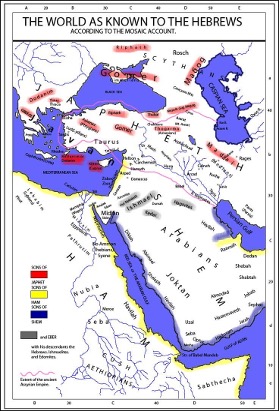
Notice that the word “delivered” is used three times. The word used is “natsal” (H5337) which literally means to “snatch away”. Sound familiar? Psa 18:17 He delivered me from my strong enemy, And from those hating me, For they were stronger than I.
Think of it this way, “natsal” means to take out of harm’s way but there is another word that means “snatch away” at it is used here: Isa 66:17 those who set themselves apart and cleanse themselves at the gardens after ‘one’ in the midst, eating flesh of pigs and the abomination and the mouse, are snatched away, together,” declares יהוה.
The word used here for “snatched away” is not natsal but “suph” (H5486) which means to terminate, end, consume, destroy. Those who argue that the “rapture” is being snatched away are correct, but it is the destination they get wrong: Luk 17:36 “Two shall be in the field, the one shall be taken and the other shall be left.”
Luk 17:37 And they answering, said to Him, “Where, Master?” And He said to them, “Where the body is, there also the vultures shall be gathered together.”
Verse 12 – This verse proves once again that Yithro was familiar with the teachings of Abraham. How else would he have known what an acceptable sacrifice to YHVH would be?
Verses 13-27 – Yithro cannot believe how busy Mosheh is and gives him some sage advice: “seek out from all the people able men”
I believe that the qualifications looked something like this: 1Ti 3:1 Trustworthy is the word: If a man longs for the position of an overseer, he desires a good work.
1Ti 3:2 An overseer, then, should be blameless, the husband of one wife, sober, sensible, orderly, kind to strangers, able to teach,
1Ti 3:3 not given to wine, no brawler, but gentle, not quarrelsome, no lover of silver,
1Ti 3:4 one who rules his own house well, having his children in subjection with all reverence,
1Ti 3:5 for if a man does not know how to rule his own house, how shall he look after the assembly of Elohim?
1Ti 3:6 Not a new convert, lest he become puffed up with pride and fall into the judgment of the devil.
1Ti 3:7 And he should even have a good witness from those who are outside, lest he fall into reproach and the snare of the devil.
1Ti 3:8 Likewise attendants are to be reverent, not double-tongued, not given to much wine, not greedy for filthy gain,
1Ti 3:9 holding to the secret of the belief with a clean conscience.
1Ti 3:10 And let these also be proved first, then let them serve, if they are unreprovable.
1Ti 3:11 Wives in the same way: reverent, not false accusers, sober, trustworthy in every way.
1Ti 3:12 Let attendants be the husbands of only one wife, ruling children and their own houses well.
1Ti 3:13 For those who have served well as attendants gain good standing for themselves, and much boldness in the belief that is in Messiah יהושע.
And like this: Tit 1:7 For an overseer has to be unreprovable, as a managing one of Elohim, not self-pleasing, not wroth, not given to wine, no brawler, not greedy for filthy gain,
Tit 1:8 but kind to strangers, a lover of what is good, sensible, righteous, set-apart, self-controlled,
Tit 1:9 clinging to the trustworthy word, according to the teaching, in order to be able both to encourage by sound teaching, and to convict those who oppose it.
Unfortunately, the sound advice of Yithro has fallen on deaf ears. Look what Mosheh (Torah) should do: A. stand before Elohim for the people; enlighten the people concerning the 1. laws; 2. Torot: B. show them the way 1. in which to walk: B. in the work they do.
Way = derek (H1870)
Walk = halak (H1980)
Work = maasiai (H4640) literally “Work of the Lord”
Do = ‘asah – H6213) to be industrious
Verse 23 speaks volumes of the wisdom of Yithro. He tells Mosheh to take it YHVH and see if it meets His approval. Even though he was in a position to influence Mosheh he instructs him to take it to YHVH and seek His approval.
Verse 27 – It would have been customary for Mosheh to accompany Yithro to the outside of the camp and basically ‘lead’ him in the direction that he was traveling.
Ahavah,
 CahalTx