Lesson date: 5/29/5855AA
Verse 1 – H662 – אפק – ‘âphaq – BDB Definition:1) to hold, be strong, restrain, hold back 1a) (Hithpael) 1a1) to restrain oneself, refrain. This word is written in the Hiphael verb form to emphasize that Yoseph was unable to restrain himself any longer. We see Yoseph dismissing everyone in his presence except his brothers. In verse 28 of the previous chapter we see Yehudah describe Yoseph’s death as “torn to pieces” and now he reveals that he is alive. Imagine how Miryam of Magdala felt when she heard a familiar voice utter, “Miryam” in John 20:16. She knew Yeshua was dead, she had watched as his flesh was torn to pieces by the whip. She had watched as Yeshua was nailed to the stake and then even as the spear was shoved between His ribs so, he had to be dead. Suddenly, to hear his familiar voice call out to her, “Miryam”.
H3318 – יצא – yâtsâ’ – BDB Definition: 1) to go out, come out, exit, go forth. Now, Yoseph commands all the Mitsrites to leave his presence. Rev 11:8 and their dead bodies lie in the street of the great city which spiritually is called Seḏom and Mitsrayim, where also our Master was impaled,
If we want to see our Messiah, our Bridegroom, we have to come out of Egypt, we must יצא – yâtsâ’ exit, go out of Egypt if we want to be left standing in front of our Master and to be called his brethren.
Joh 20:17 יהושע said to her, “Do not hold on to Me, for I have not yet ascended to My Father. But go to My brothers and say to them, ‘I am ascending to My Father and your Father, and to My Elohim and your Elohim.’ ”
Verse 2- We only see it recorded in one book, John, that Yeshua wept: Joh 11:35 יהושע wept. But did you ever stop and think about why he wept. Was he weeping because Elazar was dead? If He knew He was about to raise El’azar from the grave it seems to me that He would have been excited. Maybe He wept because He had to let El’azar taste death so that He could be reunited with someone He considered a brother. Perhaps it is similar to His weeping for Yerushalayim in that He knew what was coming: Luk 19:41 And as He came near, He saw the city and wept over it,
Luk 19:42 saying, “If you only knew even today, the matters for your peace! But now they are hidden from your eyes.
Verses 3 – 8 – Yoseph reveals himself to his brothers and they are trembling in fear: Mat 14:26 And when the taught ones saw Him walking on the sea, they were troubled, saying, “It is a phantom!” And from fear they cried.
Mat 14:27 But immediately יהושע spoke to them, saying, “Take courage, it is I, do not be afraid.”
Perhaps they too, like the apostles, thought they were seeing a ghost. Or, perhaps they thought that now, as the governor of Mitsrayim, that Yoseph would take vengeance on them. Now, like we studied last week when Yehudah “drew near” to Yoseph in Ber. 44:18 we see Yoseph commanding his brothers to “come near” nagash – H5066, same word. Luk_10:9 and heal the sick there, and say to them, ‘The reign of Elohim has come near to you.’
The grammar used in the New Testament Greek is actually bad grammar and even in English it seems bad in usage. The reason is that the New Testament was written in Hebrew and in Hebrew the grammar is correct. I am sure that in Luke 10:9 above, and many other places, the word used was “nagash”. In English it sounds as though the reign of Elohim was a “near miss” rather than something that had arrived.
Joh 20:27 Then He said to T’oma, “Bring your finger here, and see My hands. And bring your hand and put it into My side – and do not be unbelieving, but believing.”
Joh 20:28 And T’oma answered and said to Him, “My Master and my Elohim!”
All of those who are outside the covenant have been sent or taken away and it is just those in covenant in his presence, Yoseph revealed himself just like Yeshua revealed Himself to his brethren and it is at that time that Thomas declares “My Master and my Elohim.”
Eph 2:11 Therefore remember that you, once gentiles in the flesh, who are called ‘the uncircumcision’ by what is called ‘the circumcision’ made in the flesh by hands,
Eph 2:12 that at that time you were without Messiah, excluded from the citizenship of Yisra’ĕl and strangers from the covenants of promise, having no expectation and without Elohim in the world.
Eph 2:13 But now in Messiah יהושע you who once were far off have been brought near by the blood of the Messiah.
Brought near in Greek is: G1451 – ἐγγύς – eggus – eng-goos’ – From a primary verb ἄγχω agchō (to squeeze or throttle; akin to the base of G43); near (literally or figuratively, of place or time): – from, at hand, near. What is so important about G1451? It is the root word for the reflexive form G1448 used in verse 4 for “come near” and the identical word used in verse 10.
In verse 5 we see Yoseph telling his brothers that his coming to Mitsrayim was Yah’s plan so that he could preserve life: Joh 3:16 “For Elohim so loved the world that He gave His only brought-forth Son, so that everyone who believes in Him should not perish but possess everlasting life.
Joh 3:17 “For Elohim did not send His Son into the world to judge the world, but that the world through Him might be saved.
Verse 6 reminds me of the pictures, documentaries and stories I heard about the dust bowl years in the midwest. It was useless to plough and plant. People’s fences was buried under dust. I have seen a picture and in real life, in a museum, a crow’s nest built of pieces of barbed wire because there was no vegetation of any kind to use to build a nest. This is how I imagine the famine of Mitsrayim.
Verse 7 shows us that Yoseph wasn’t trying to save the whole world, only a remnant: Isa_1:9 Except Jehovah of Hosts had left us a very small remnant, we would be as Sodom; we would be like Gomorrah.
Isa_10:21 The remnant shall return, the remnant of Jacob, to the mighty God.
What will be the means by which the remnant will be preserved? A great escape (verse 7): Isa 4:2 In that day the Branch of יהוה shall be splendid and esteemed. And the fruit of the earth shall be excellent and comely for the escaped ones of Yisra’ĕl.
Joe 2:32 “And it shall be that everyone who calls on the Name of יהוה shall be delivered. For on Mount Tsiyon and in Yerushalayim there shall be an escape as יהוה has said, and among the survivors whom יהוה calls.
Oba 1:17 “But on Mount Tsiyon there shall be an escape, and they shall be set-apart. And the house of Yaʽaqoḇ shall possess their possessions.
Escape = פְלֵיטָה peletah – Strong’s H6413
And once again in verse 8 Yoseph tells his brothers that they did not send him to Mitsrayim but YHVH.
He assures his brothers that it was the will of Elohim: Joh 15:16 “You did not choose Me, but I chose you and appointed you that you should go and bear fruit, and that your fruit should remain, so that whatever you ask the Father in My Name He might give you.
Verses 9-11 Yoseph tells them to “hurry” = mahar – Strong’s H4116 back to his father and inform him of what has happened. In verse 10 Yoseph explains his plan for preserving their families in the land of Goshen. Okay, big coincidence here: H1657 – גּשׁן – gôshen – BDB Definition: Goshen = “drawing near”. It is said to have an unknown origin but I feel as though it came from nagash – H5066. Notice that the same letters are used, just in a different order – g/sh/n and n/g/sh.
Goshen is by far the best soil in Mitsrayim, with thick grass for the flocks and it was sparsely populated because most people lived along the main channel of the river so that when the annual floods came they could use the flood waters to water their fields. The Nile is like the Mississippi River in that it is laden with topsoil that has washed down for thousands, if not, millions of square miles of farmland. By watering with this river water farmers were renewing their depleted topsoil. It was in the delta country where the bulk of the topsoil was deposited and there could be found the richest soils. But there was a slight problem, it was near the coast and was an easy target for the Philistines to raid and it was far removed for the seat of power of the Mitsrian government and so fewer soldiers were near.
Looking at verse 10 we see that Yoseph explains that they will be living in Goshen which is near him. Why would Yoseph be near to Goshen? The seat of power was in Memphis a hundred miles away. What reason would Yoseph have in being near to Goshen. Easy. His father-in-law was Poti-pherah and he was the priest of On and On was the main center of Sun worship and it was on the border of Goshen.
We know it in history as Heliopolis but to this day it is called ⲱⲛ or On by the Copts (Coptic Christians). On is just a suburb of Cairo now and most of the greatness of the sun worship is gone except the obelisk of the god Ra-Atum, the sun god.
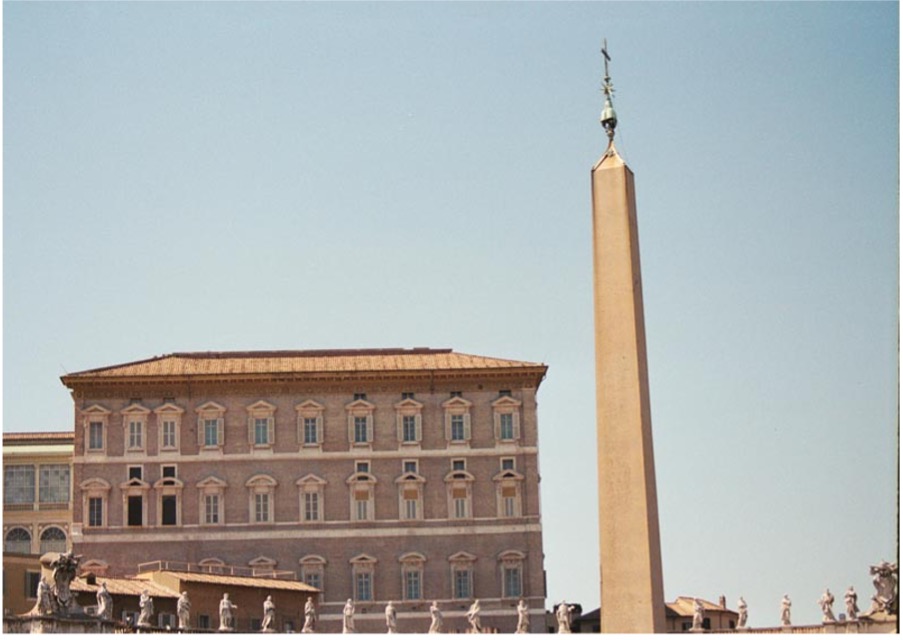 This is the obelisk in St. Peter’s Square in Vatican City. It is almost identical to the one that was located in On, except a cross was added to the top to make it more Christian.
The following was taken for St. Peter’s Basilica website so, I will let them explain it to you: From: ‘Seminarians Guide’
Obelisk is from obeliscus – “in the shape of a spear”. For pagans, the obelisk was a solar symbol that represented a vital flow between heaven and earth, a way of communicating to the divine.
As a pagan monument in the greatest Christian square, it is a symbol of humanity reaching out to Christ. Originally inscribed to “Divine Augustus” and “Divine Tiberius” and now dedicated to the Holy Cross – “Christus Vincit, Christus Regnat, Christus Imperat. Christus ab omni malo plebem suam defendat.” It is topped by a bronze cross containing a fragment of the true Cross. (I highlighted some of the important parts.)
Exo 23:24 “Do not bow down to their mighty ones, nor serve them, nor do according to their works, but without fail overthrow them and without fail break down their pillars.
Verse 12 – I wanted to separate verse 12 from the rest because of the construction of the verse if odd. What is being conveyed in English is: “(You are not dreaming) Open your eyes and hear me.” We see this same type of construction in Exo. 20:18 where we read: Exo 20:18 And all the people saw the thunders,
Verses 13-15 – They were instructed to relay a message to Yisra’el that they should hurry back. We see Binyamin and Yosef loving one another and then Yosef kissed his other brothers.
Verses 16-20 – Now the news (Good News) gets back to Pharoah and he in turn adds his blessing and promise to give Yoseph’s brothers the best of the land. He tells them something that the people here in America would never consider: Gen 45:20 ‘And do not be concerned about your goods,
Why this is tantamount to sacrilege in America. He should have said, “Rent storage units, for some day in the future you might need those things.” Materialism has permeated every aspect of American life, yes, even the Church. Perhaps I should have said “especially” the Church.
Verses 21-22 – Yoseph gives them an abundant supply of food to take back to their families He also gives his brothers changes of garments. This represents Yeshua given us clean robes for the wedding feast. Here is an example: Zec 3:3 And Yehoshua was dressed in filthy garments, and was standing before the messenger.
Zec 3:4 And He answered and spoke to those who stood before Him, saying, “Remove the filthy garments from him.” And to him He said, “See, I have removed your guilt from you, and shall put costly robes on you.”
I would like to think that the five changes of garments that he gave Binyamin represent the five books of Torah and how we should “change” into Torah daily. The letter שׁ represents the number 300. Three hundred represents “Victory over the forces of evil”. Ring a bell? That is exactly what Yeshua did with His death, burial and resurrection, He was victorious over Hasatan and his evil minions: 1Co 2:7 But we speak the wisdom of Elohim, which was hidden in a secret, and which Elohim ordained before the ages for our esteem,
1Co 2:8 which no one of the rulers of this age knew, for if they had known, they would not have impaled the Master of esteem.
Three hundred also represents an appointed time – Election: (KJV) 1Pe_1:2 Elect according to the foreknowledge of God the Father, through sanctification of the Spirit, unto obedience and sprinkling of the blood of Jesus Christ: Grace unto you, and peace, be multiplied.
Mat_24:22 And except those days should be shortened, there should no flesh be saved: but for the elect’s sake those days shall be shortened.
Mat_24:24 For there shall arise false Christs, and false prophets, and shall shew great signs and wonders; insomuch that, if it were possible, they shall deceive the very elect.
Mat_24:31 And he shall send his angels with a great sound of a trumpet, and they shall gather together his elect from the four winds, from one end of heaven to the other.
Verses 23-24 – Yoseph sends his father 10 donkeys loaded with the best of the land and ten female donkeys loaded with food.
In verse 24 Yoseph tells his brothers not to quarrel. What is there to quarrel over?
Verses 25-28 – The brothers return to Kena’an and tell the Good News to their father that Yoseph is alive and is now governor over all Mitsrayim. The brother who was “dead” to his family is now found alive and ruling, an awesome picture. In verse 28 when Yisra’el says “Enough” he is literally saying “That is an abundant amount of good news.”
Let me go and see him before I die.
Ahavah.
Lesson date: 11/20/5858AA
Sometimes the most powerful pictures lie hidden and you have to seek them out. Yoseph, standing there in his own house and is standing in front of his brothers. Everyone who is not one of his brethren is harshly told to leave his house and, by extension his fathers house, and he stands alone with his brothers: Joh 14:2 “In My Father’s house are many staying places. And if not, I would have told you. I go to prepare a place for you.
Joh 14:3 “And if I go and prepare a place for you, I shall come again and receive you to Myself, that where I am, you might be too.
Do we see Yeshu’a order out those who are not His brothers? Mat 7:23 “And then I shall declare to them, ‘I never knew you, depart from Me, you who work lawlessness!’
Verse 1 – H662 – אפק – ‘âphaq – BDB Definition:1) to hold, be strong, restrain, hold back 1a) (Hithpael) 1a1) to restrain oneself, refrain. This word is written in the Hiphael verb form to emphasize that Yoseph was unable to restrain himself any longer. We see Yoseph dismissing everyone in his presence except his brothers. In verse 28 of the previous chapter we see Yehudah describe Yoseph’s death as “torn to pieces” and now he reveals that he is alive. Imagine how Miryam of Magdala felt when she heard a familiar voice utter, “Miryam” in John 20:16. She knew Yeshua was dead, she had watched as his flesh was torn to pieces by the whip. She had watched as Yeshua was nailed to the stake and then even as the spear was shoved between His ribs so, he had to be dead. Suddenly, to hear his familiar voice call out to her, “Miryam”.
H3318 – יצא – yâtsâ’ – BDB Definition: 1) to go out, come out, exit, go forth. Now, Yoseph commands all the Mitsrites to leave his presence. Rev 11:8 and their dead bodies lie in the street of the great city which spiritually is called Seḏom and Mitsrayim, where also our Master was impaled,
If we want to see our Messiah, our Bridegroom, we have to come out of Egypt, we must יצא – yâtsâ’ exit, go out of Egypt if we want to be left standing in front of our Master and to be called his brethren.
Joh 20:17 יהושע said to her, “Do not hold on to Me, for I have not yet ascended to My Father. But go to My brothers and say to them, ‘I am ascending to My Father and your Father, and to My Elohim and your Elohim.’ ”
Verse 2- We only see it recorded in one book, John, that Yeshua wept: Joh 11:35 יהושע wept. But did you ever stop and think about why he wept. Was he weeping because Elazar was dead? If He knew He was about to raise El’azar from the grave it seems to me that He would have been excited. Maybe He wept because He had to let El’azar taste death so that He could be reunited with someone He considered a brother. Perhaps it is similar to His weeping for Yerushalayim in that He knew what was coming: Luk 19:41 And as He came near, He saw the city and wept over it,
Luk 19:42 saying, “If you only knew even today, the matters for your peace! But now they are hidden from your eyes.
If you use E-Sword, or something similar, look at the construction of Verse 2: Gen 45:2 And he wept aloud:H5414 (H853) H6963 H1065
Do you see it? Where is the direct object?
Verses 3 – 8 – Yoseph reveals himself to his brothers and they are trembling in fear: Mat 14:26 And when the taught ones saw Him walking on the sea, they were troubled, saying, “It is a phantom!” And from fear they cried.
Mat 14:27 But immediately יהושע spoke to them, saying, “Take courage, it is I, do not be afraid.”
Perhaps they too, like the apostles, thought they were seeing a ghost. Or, perhaps they thought that now, as the governor of Mitsrayim, that Yoseph would take vengeance on them. Now, like we studied last week when Yehudah “drew near” to Yoseph in Ber. 44:18 we see Yoseph commanding his brothers to “come near” nagash – H5066, same word. Luk_10:9 and heal the sick there, and say to them, ‘The reign of Elohim has come near to you.’
The grammar used in the New Testament Greek is actually bad grammar and even in English it seems bad in usage. The reason is that the New Testament was written in Hebrew and in Hebrew the grammar is correct. I am sure that in Luke 10:9 above, and many other places, the word used was “nagash”. In English it sounds as though the reign of Elohim was a “near miss” rather than something that was within reach.
Joh 20:27 Then He said to T’oma, “Bring your finger here, and see My hands. And bring your hand and put it into My side – and do not be unbelieving, but believing.”
Joh 20:28 And T’oma answered and said to Him, “My Master and my Elohim!”
All of those who are outside the covenant have been sent or taken away and it is just those in covenant in his presence, Yoseph revealed himself just like Yeshua revealed Himself to his brethren and it is at that time that Thomas declares “My Master and my Elohim.”
Eph 2:11 Therefore remember that you, once gentiles in the flesh, who are called ‘the uncircumcision’ by what is called ‘the circumcision’ made in the flesh by hands,
Eph 2:12 that at that time you were without Messiah, excluded from the citizenship of Yisra’ĕl and strangers from the covenants of promise, having no expectation and without Elohim in the world.
Eph 2:13 But now in Messiah יהושע you who once were far off have been brought near by the blood of the Messiah.
Brought near in Greek is: G1451 – ἐγγύς – eggus – eng-goos’ – From a primary verb ἄγχω agchō (to squeeze or throttle; akin to the base of G43); near (literally or figuratively, of place or time): – from, at hand, near. What is so important about G1451? It is the root word for the reflexive form G1448 used in verse 4 for “come near” and the identical word used in verse 10.
In verse 5 we see Yoseph telling his brothers that his coming to Mitsrayim was Yah’s plan so that he could preserve life: Joh 3:16 “For Elohim so loved the world that He gave His only brought-forth Son, so that everyone who believes in Him should not perish but possess everlasting life.
Joh 3:17 “For Elohim did not send His Son into the world to judge the world, but that the world through Him might be saved.
There is another verse of Scripture that this scene reminds me of: Psa 23:5 You spread before me a table in the face of my enemies; You have anointed my head with oil; My cup runs over.
Verse 6 reminds me of the pictures, documentaries and stories I heard about the dust bowl years in the midwest. It was useless to plough and plant. People’s fences was buried under dust. I have seen a picture and in real life, in a museum, a crow’s nest built of pieces of barbed wire because there was no vegetation of any kind to use to build a nest. This is how I imagine the famine of Mitsrayim.
Verse 7 shows us that Yoseph wasn’t trying to save the whole world, only a remnant: Isa 1:9 Unless יהוה of hosts had left to us a small remnant, we would have become like Seḏom, we would have been made like Amorah.
Isa 10:20 And in that day it shall be that the remnant of Yisra’ěl, and those who have escaped of the house of Ya‛aqoḇ, never again lean upon him who struck them, but shall lean upon יהוה, the Set-apart One of Yisra’ěl, in truth.
Isa 10:21 A remnant shall return, the remnant of Ya‛aqoḇ, to the Mighty Ěl.
What will be the means by which the remnant will be preserved? A great escape (verse 7): Isa 4:2 In that day the Branch of יהוה shall be splendid and esteemed. And the fruit of the earth shall be excellent and comely for the escaped ones of Yisra’ĕl.
Joe 2:32 “And it shall be that everyone who calls on the Name of יהוה shall be delivered. For on Mount Tsiyon and in Yerushalayim there shall be an escape as יהוה has said, and among the survivors whom יהוה calls.
Oba 1:17 “But on Mount Tsiyon there shall be an escape, and they shall be set-apart. And the house of Yaʽaqoḇ shall possess their possessions.
Escape = פְלֵיטָה peletah – Strong’s H6413
And once again in verse 8 Yoseph tells his brothers that they did not send him to Mitsrayim but YHVH.
He assures his brothers that it was the will of Elohim: Joh 15:16 “You did not choose Me, but I chose you and appointed you that you should go and bear fruit, and that your fruit should remain, so that whatever you ask the Father in My Name He might give you.
Verses 9-11 Yoseph tells them to “hurry” = mahar – Strong’s H4116 back to his father and inform him of what has happened. In verse 10 Yoseph explains his plan for preserving their families in the land of Goshen. Okay, big coincidence here: H1657 – גּשׁן – gôshen – BDB Definition: Goshen = “drawing near”. It is said to have an unknown origin but I feel as though it came from nagash – H5066. Notice that the same letters are used, just in a different order – g/sh/n and n/g/sh.
Goshen is by far the best soil in Mitsrayim, with thick grass for the flocks and it was sparsely populated because most people lived along the main channel of the river so that when the annual floods came they could use the flood waters to water their fields. The Nile is like the Mississippi River in that it is laden with topsoil that has washed down for thousands, if not, millions of square miles of farmland. By watering with this river water farmers were renewing their depleted topsoil. It was in the delta country where the bulk of the topsoil was deposited and there could be found the richest soils. But there was a slight problem, it was near the coast and was an easy target for the Philistines to raid and it was far removed for the seat of power of the Mitsrian government and so fewer soldiers were near.
Looking at verse 10 we see that Yoseph explains that they will be living in Goshen which is near him. Why would Yoseph be near to Goshen? The seat of power was in Memphis a hundred miles away. What reason would Yoseph have in being near to Goshen. Easy. His father-in-law was Poti-pherah and he was the priest of On and On was the main center of Sun worship and it was on the border of Goshen.
We know it in history as Heliopolis but to this day it is called ⲱⲛ or On by the Copts (Coptic Christians). On is just a suburb of Cairo now and most of the greatness of the sun worship is gone except the obelisk of the god Ra-Atum, the sun god.
This is the obelisk in St. Peter’s Square in Vatican City. It is almost identical to the one that was located in On, except a cross was added to the top to make it more Christian.
The following was taken for St. Peter’s Basilica website so, I will let them explain it to you: From: ‘Seminarians Guide’:
Obelisk is from obeliscus – “in the shape of a spear”. For pagans, the obelisk was a solar symbol that represented a vital flow between heaven and earth, a way of communicating to the divine.
As a pagan monument in the greatest Christian square, it is a symbol of humanity reaching out to Christ. Originally inscribed to “Divine Augustus” and “Divine Tiberius” and now dedicated to the Holy Cross – “Christus Vincit, Christus Regnat, Christus Imperat. Christus ab omni malo plebem suam defendat.” It is topped by a bronze cross containing a fragment of the true Cross. (I highlighted some of the important parts.)
Exo 23:24 “Do not bow down to their mighty ones, nor serve them, nor do according to their works, but without fail overthrow them and without fail break down their pillars.
Verse 12 – I wanted to separate verse 12 for the rest because of the construction of the verse if odd. What is being conveyed in English is: “(You are not dreaming) Open you eyes and hear me.” We see this same type of construction in Exo. 20:18 where we read: Exo 20:18 And all the people saw the thunders,
Verses 13-15 – They were instructed to relay a message to Yisra’el that they should hurry back. We see Binyamin and Yosef loving one another and then Yosef kissed his other brothers.
Verses 16-20 – Now the news (Good News) gets back to Pharoah and he in turn adds his blessing and promise to give Yoseph’s brothers the best of the land. He tells them something that the people here in America would never consider: Gen 45:20 ‘And do not be concerned about your goods,
Why this is tantamount to sacrilege in America. He should have said, “Rent storage units, for some day in the future you might need those things.” Materialism has permeated every aspect of American life, yes, even the Church. Perhaps I should have said “especially” the Church.
Verses 21-22 – Yoseph gives them anbundant supply of food to take back to their families He also gives his brothers changes of garments. This represents Yeshua given us clean robes for the wedding feast. Here is an example: Zec 3:3 And Yehoshua was dressed in filthy garments, and was standing before the messenger.
Zec 3:4 And He answered and spoke to those who stood before Him, saying, “Remove the filthy garments from him.” And to him He said, “See, I have removed your guilt from you, and shall put costly robes on you.”
I would like to think that the five changes of garments that he gave Binyamin represent the five books of Torah and how we should “change” into Torah daily. The letterשׁ represents the number 300. Three hundred represents “Victory over the forces of evil”. Ring a bell? That is exactly what Yeshua did with His death, burial and resurrection, He was victorious over Hasatan and his evil minions: 1Co 2:7 But we speak the wisdom of Elohim, which was hidden in a secret, and which Elohim ordained before the ages for our esteem,
1Co 2:8 which no one of the rulers of this age knew, for if they had known, they would not have impaled the Master of esteem.
Three hundred also represents an appointed time – Election: (KJV) 1Pe_1:2 Elect according to the foreknowledge of God the Father, through sanctification of the Spirit, unto obedience and sprinkling of the blood of Jesus Christ: Grace unto you, and peace, be multiplied.
Mat_24:22 And except those days should be shortened, there should no flesh be saved: but for the elect’s sake those days shall be shortened.
Mat_24:24 For there shall arise false Christs, and false prophets, and shall shew great signs and wonders; insomuch that, if it were possible, they shall deceive the very elect.
Mat_24:31 And he shall send his angels with a great sound of a trumpet, and they shall gather together his elect from the four winds, from one end of heaven to the other.
Verses 23-24 – Yoseph sends his father 10 donkeys loaded with the best of the land and ten female donkeys loaded with food.
In verse 24 Yoseph tells his brothers not to quarrel. What is there to quarrel over?
Verses 25-28 – The brothers return to Kena’an and tell the Good News to their father that Yoseph is alive and is now governor over all Mitsrayim. The brother who was “dead” to his family is now found alive and ruling, an awesome picture.
Rev 1:17 And when I saw Him, I fell at His feet as dead, and He placed His right hand on me, saying, “Do not be afraid, I am the First and the Last,
Rev 1:18 and the living One. And I became dead, and see, I am living forever and ever. Aměn. And I possess the keys of She’ol and of Death.
In verse 28 when Yisra’el says “Enough” he is literally saying “That is an abundant amount of good news.” “Let me go and see him before I die.”
Ahavah vberakhot,
 CahalTx