Lesson date: 11/5/5854AA
Verses 1-3 – Please remember that in Ber. 1:1 we discussed the fact that word 4 and 6 were Aleph/Tav H853. We discussed the prophetic nature of the placement of the words in that Yeshua came in the 4 millennium of Creation and will come again in the sixth millennium of the Creation Week.
In verse 1-2 we see the use of the word completed – H3615 – כָּלָה – kâlâh – kaw-law’ – A primitive root; to end, whether intransitively (to cease, be finished, perish) or transitively (to complete, The root word for H3615 is H3618 – ((Hold your breath!)) – H3618 – כַּלָּה – kallâh – kal-law’ – From H3634; a bride (as if perfect);
You could almost translate the first sentence in verse 2 as: And in the seventh day Elohim completed His Bride, perfect. It is a beautiful picture of YHVH taking His Bride in the 7th millennium.
In verse 2 we see the phrase “And He rested” – H7673 – שָׁבַת – shâbath – shaw-bath’ – A primitive root; to repose, that is, desist from exertion; used in many implied relations (causatively, figuratively or specifically): – (cause to, let, make to) cease, celebrate, cause (make) to fail, keep (sabbath), suffer to be lacking, leave, put away (down), (make to) rest, rid, still, take away.
“On the seventh day” – H7637 – שְׁבִעִי שְׁבִיעִי – shebı̂y‛ı̂y shebi‛ı̂y – sheb-ee-ee’, sheb-ee-ee’ – Ordinal from H7657; seventh: – seventh (time).
Both H7673 and H7637 come from H7650 – שָׁבַע – shâba‛ – shaw-bah’ – A primitive root; properly to be complete, but used only as a denominative from H7651; to seven oneself, that is, swear (as if by repeating a declaration seven times): – adjure, charge (by an oath, with an oath), feed to the full [by mistake for H7646], take an oath, X straitly, (cause to, make to) swear.
Each Shabbat we renew our vow to YHVH by observing His Covenant with us. Exo 31:13 “And you, speak to the children of Yisra’ĕl, saying, ‘My Sabbaths you are to guard, by all means, for it is a sign between Me and you throughout your generations, to know that I, יהוה, am setting you apart.
Eze 20:12 “And I also gave them My Sabbaths, to be a sign between them and Me, to know that I am יהוה who sets them apart.
Verse 3 – “And Elohim blessed the seventh day” – blessed – H1288 – בָּרַךְ – bârak – baw-rak’ – A primitive root; to kneel; by implication to bless God (as an act of adoration), and (vice-versa) man (as a benefit); also (by euphemism) to curse (God or the king, as treason): – X abundantly, X altogether, X at all, blaspheme, bless, congratulate, curse, X greatly, X indeed, kneel (down), praise, salute, X still, thank. And the very next word is H853: Mat 12:8 “For the Son of Aḏam is Master of the Sabbath.”
Mar 2:28 “So the Son of Adam is also Master of the Sabbath.
Luk 6:5 And He said to them, “The Son of Adam is Master of the Sabbath.”
In trying to sum up what is being explained here I will do my best but I believe it is beyond my abilities.
Blessed = barak = H1288 + H853
set apart = Kadash = H6942 –
rested = shabbath = H7673 =
created = baraa = H1254
Barak = The family’s leader has opened(extended) His Hand (to us.)
b =tent, house, floor plan
r = head, leader, power, El
k = open hand, open, allow, tame, bend
Ayth =
a = strong, leader, El (beginning)
t = crossed sticks, covenant, mark, sign, monument (end)
Qadash = Continually coming to the Door to meditate (on His Word).
q = circle, time, condense ((sun on the horizon as in = in the beginning, in the end))
d = door, move, hang, entrance
s = chew, word, ruminate/meditate, sharp, press, eat, destroy
Shabbath = The Word of His House is our covenant.
s = chew, ruminate, word, etc.
b = tent, house, family
t = sign of the covenant, mark, sign, signal, covenant
Baraa = (Bar) The Son of Elohim created (all).
b = house, family, tent
r = head, leader, first, top, beginning
a = strong, power, leader, El
THE LEADER OF OUR FAMILY HAS EXTENDED HIS HAND TO US, ELOHIM’S COVENANT, TO ENABLE US TO CONTINUALLY COME TO THE DOOR (OF THE TENT OF APPOINTMENT) TO MEDITATE ON HIS WORD AND THE WORD OF HIS HOUSE IS OUR COVENANT, THE SON OF ELOHIM, WHO CREATED ALL.
Shabbat (H7676) means intermission, rest, specifically the Sabbath. To me, it is a time to let my mind rest from the cares of the world and to genuinely study His Word. A time to give thanks for blessings, to call on His Name for healing, both physical and spiritual. It is a time to shut out the world as much as possible and by only understanding His Shabbat can we hope to understand His Word.
Act 15:21 “For from ancient generations Mosheh has, in every city, those proclaiming him – being read in the congregations every Sabbath.”
Verse 4 – Births = H8435 – תֹּלְדָה תּוֹלְדָה – tôledâh tôledâh – to-led-aw’, to-led-aw’ – From H3205; (plural only) descent, that is, family; (figuratively) history: – birth, generations.
Verse 5 – “Shrub of the field”, “plant of the field” = domesticated plants. In verses 1:11-12 we see trees, shrubs and grass growing and producing seed, but these are different.
“There was no man to till the Earth.” Man was created on the Sixth Day but these men were hunters and gatherers, the earliest form of civilization. The “man” being spoken of here is a farmer: H5647 – עָבַד – ‛âbad – aw-bad’ – A primitive root; to work (in any sense); by implication to serve, till, (causatively) enslave, etc.: – X be, keep in bondage, be bondmen, bond-service, compel, do, dress, ear, execute, + husbandman, keep, labour (-ing man), bring to pass, (cause to, make to) serve (-ing, self), (be, become) servant (-s), do (use) service, till (-er), transgress [from margin], (set a) work, be wrought, worshipper.
Mat 21:33 Hear another parable: There was a certain householder,(YHVH) which planted a vineyard,(Eden) and hedged it round about, and digged a winepress in it, and built a tower, and let it out to husbandmen,(farmers) and went into a far country:
Mat 21:34 And when the time of the fruit drew near, he sent his servants (Prophets) to the husbandmen, that they might receive the fruits of it.
Mat 21:35 And the husbandmen took his servants, and beat one, and killed another, and stoned another.
Mat 21:36 Again, he sent other servants more than the first: and they did unto them likewise.
Mat 21:37 But last of all he sent unto them his son, (Yeshua/Son of Adam) saying, They will reverence my son.
Mat 21:38 But when the husbandmen saw the son, they said among themselves, This is the heir; come, let us kill him, and let us seize on his inheritance.
Mat 21:39 And they caught him, and cast him out of the vineyard, and slew him.
Mat 21:40 When the lord therefore of the vineyard cometh, what will he do unto those husbandmen?
Verse 6 – The entire Earth was watered by a mist without rain.
Verse 7 – Formed man – H3335 – יָצַר – yâtsar – yaw-tsar’ – probably identical with H3334 (through the squeezing into shape); (compare H3331); to mould into a form; especially as a potter; figuratively to determine (that is, form a resolution): – X earthen, fashion, form, frame, make (-r), potter, purpose.
Created man (Ber. 1:27) – H1254 – בָּרָא – bârâ’ – baw-raw’ – A primitive root; (absolutely) to create; (qualified) to cut down (a wood), select, feed (as formative processes): – choose, create (creator), cut down, dispatch, do, make (fat).
Breath of lives – H2416 – חַי – chay – khah’ee – multitude, company, congregation, troop
Verse 8 – ((WOW)) – garden = H1588 – gan. Now look at it in Greek – G3857 – παράδεισος – paradeisos – par-ad’-i-sos – Of Oriental origin (compare [H6508]); a park, that is, (specifically) an Eden (place of future happiness, “paradise”): – paradise.
Luk 23:43 And יהושע said to him, “Truly, I say to you today, you shall be with Me in Paradise.”
Same word! G3857.
Verses 10-14 – Let’s look at the four (4) rivers flowing out of Eden. Two we are pretty sure of and that is the Tigris and the Euphrates. The Hebrew matches up so we don’t have a lot of detective work to do. It is the Pishon and Gihon that are the most troubling, especially the Gihon. Let’s look at it again: Gen 2:13 And the name of the second river is Giḥon, it is the one surrounding the entire land of Kush.
Now, everyone and their brother knows that Kush or Cush is basically Ethiopia and that part of Africa, right? Maybe. Maybe we are “assuming” too much. Is there another Kush? Let’s look:

Kush, also called the Kushan Empire and also called Hindu-Kush matches the description of Kush in Genesis 2:13. What is the name of the river today? Amu Darya. Darya means river in Persian so it is the Amu River.
Did you know that in Egyptian there is no “J” sound? In Egyptian there is a “J” character but it is pronounced as a “G”. Do you know the name of this river in Arabic? Jehoon. But Moses was from Egypt and they have no “J” but rather a “G” and so the river in Egyptian is Gee-hoon. Why doesn’t the river flow out of Eden but rather flows from the Himalayas into the Caspian? Tectonic upheaval is my best guess.
Did you know that Mt. Ararat is a volcano? You know, stones of fire?
Mount Ararat
From Wikipedia, the free encyclopedia
For other meanings see Mount Ararat (disambiguation).
|
|
|
|
Little Ararat (left) and Greater Ararat (right); View from Yerevan, Armenia |
|
|
Highest point |
|
|
5,137 m (16,854 ft) |
|
|
3,611 m (11,847 ft) [1] |
|
|
379 kilometres (235 mi) |
|
|
39°42.113′N 44°17.899′ECoordinates: 39°42.113′N 44°17.899′E [2] |
|
|
Geography |
|
|
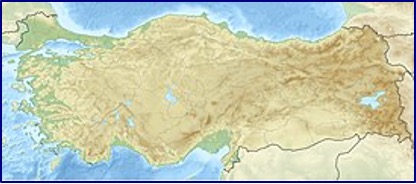
Location in Turkey |
|
|
Location |
Iğdır and Ağrı provinces, Turkey |
|
Geology |
|
|
July 2, 1840 |
|
|
Climbing |
|
|
9 October [O.S. 27 September] 1829 |
|
|
Designations |
|
|
IUCN Category II (National Park) |
|
|
Official name |
Ağrı Dağı Milli Parkı |
|
Designated |
1 November 2004[3] |
Mount Ararat (/ˈærəˌræt/ ARR-ə-rat;[4] Turkish: Ağrı Dağı; Armenian: Մասիս, Masis and Արարատ, Ararat) is a snow-capped and dormant compound volcano in the extreme east of Turkey. It consists of two major volcanic cones: Greater Ararat, the highest peak in Turkey and the Armenian plateau with an elevation of 5,137 m (16,854 ft); and Little Ararat, with an elevation of 3,896 m (12,782 ft).[5] The Ararat massif is about 40 km (25 mi) in diameter.
Verse 15 – Elohim took the man and put him in the garden. He was made outside the garden. Adam was put in the garden to work it and to GUARD it.
Verses 16-17 – I do not know what the tree of the knowledge of good and evil was. The only thing that I think of when I hear this is Torah.
Rom_3:20 Therefore by works of Torah no flesh shall be declared right before Him, for by the Torah is the knowledge of sin.
Rom_7:7 What, then, shall we say? Is the Torah sin? Let it not be! However, I did not know sin except through the Torah. For also the covetousness I knew not if the Torah had not said, “You shall not covet.”
Rom_7:9 And I was alive apart from the Torah once, but when the command came, the sin revived, and I died.
1Co_15:56 And the sting of death is the sin, and the power of the sin is the Torah.
“for in the day that you eat of it you shall certainly die.” Gen 5:5 So all the days that Aḏam lived were nine hundred and thirty years, and he died.
Did YHVH lie? No! Psa_90:4 For a thousand years in Your eyes Are like yesterday that has past, Or like a watch in the night.
2Pe_3:8 But, beloved ones, let not this one matter be hidden from you: that with יהוה one day is as a thousand years, and a thousand years as one day.
If Adam was only 930 years old when he died, he died in the same day of Creation in which he was made.
Verse 19 – The animals were made from the soil of the garden but man was not.
Verses 18&21-22 – I am going to make a helper – H6213 – עָשָׂה – ‛âśâh – aw-saw’ – ((Asah means a lot of things but two of the meanings are make and form.))
Why did YHVH use a rib? The conventional wisdom is that by using a rib they were equal. Not from the head to be over a man and not a bone from the foot to be trodden down by man. Maybe. But let’s look back to Ber. 1:27 for a clue: H5347 – נְקֵבָה – neqêbâh – nek-ay-baw’ – From H5344; female (from the sexual form): – female, woman.
H5344 – נָקַב – nâqab – naw-kab’ – A primitive root; to puncture, literally (to perforate, with more or less violence) or figuratively (to specify, designate, libel): – appoint, blaspheme, bore, curse, express, with holes, name, pierce, strike through.
Probably just a coincidence. Oops, just one more thing in verse 22 – the phrase “And the rib” let’s look at it in the KJV+ Gen 2:22 And (H853) the rib, H6763
H6763 – צַלְעָה – צֵלָע – tsêlâ‛ tsal‛âh – tsay-law’, tsal-aw’ – From H6760; a rib (as curved), literally (of the body) or figuratively (of a door, that is, leaf); hence a side, literally (of a person)
Verse 23 – What flesh? A rib is just a bone, right? Not really, look closely at the definition.
Verse 24 – “and they shall become one flesh.” They are still two separate individuals but they are in agreement, one accord. Joh 10:30 “I and My Father are one.”
Joh 17:11 “And I am no more in the world, but these are in the world, and I come to You. Set-apart Father, guard them in Your Name which You have given Me, so that they might be one, as We are.
Joh 17:20 “And I do not pray for these alone, but also for those believing in Me through their word,
Joh 17:21 so that they all might be one, as You, Father, are in Me, and I in You, so that they too might be one in Us, so that the world might believe that You have sent Me.
Joh 17:22 “And the esteem which You gave Me I have given them, so that they might be one as We are one,
Joh 17:23 “I in them, and You in Me, so that they might be perfected into one, so that the world knows that You have sent Me, and have loved them as You have loved Me.
Ahavah,
Lesson date: 01/23/5858AA
Right at the outset we will need to look very closely as to the action being performed. Sometimes we believe the Word says something that it does not. Many times I have heard people expound on the following verses on how God (YHVH) establishes the sabbath in Verse 2 and that is an incorrect statement. Let’s look at what is being said in Hebrew and compare that to our English.
Verse 1 – All of the heavens and the Earth were completed and everything in them.
Verse 2-3 – ביוֹם שְּביעיְּ
The word in green is bayyom. Remember, the initial beyt is a prefix “in, on” like Bemidbar.
The word in yellow is Shebiy’yi (or Shebi’ya) and means seventh. It is an ordinal number and comes from the root word Sheb’a – H7651 – שׁבעה / שׁבע – sheba‛ / shib‛âh – BDB Definition: 1) seven (cardinal number) 1a) as ordinal number. Now, I am doing this the long way around the barn to close the door on purpose. Sheba’ comes from the root word: H7650 – שׁבע – shâba‛ – BDB Definition:1) to swear, adjure 1a) (Qal) sworn (participle) 1b) (Niphal) 1b1) to swear, take an oath 1b2) to swear (of Jehovah by Himself) 1b3) to curse 1c) (Hiphil) 1c1) to cause to take an oath 1c2) to adjure. As in be’ersheba the well of the oath.
The next word is: H3615 – כּלה – kâlâh – BDB Definition: 1) to accomplish, cease, consume, determine, end, fail, finish, be complete, be accomplished, be ended, be at an end, be finished, be spent.
You are gonna love this word. When a young Hebrew man becomes betrothed he returns to his father’s house for an indefinite period of time, usually a year or less, and he builds an addition onto his father’s house and makes the furniture and other preparations for his future bride. After careful inspection of the handywork of the son the father will tell the young man to go and get his new daughter tonight or tomorrow night. The work of the preparation for the bride has now ended. The word for bride is: H3618 – כּלּה – kallâh – BDB Definition: 1) bride, daughter-in-law 1a) daughter-in-law 1b) bride, young wife
Notice any difference in spelling? There is no difference in the consonants between the 2 words.
So, now armed with this knowledge translate was is being inferred: On the seventh day Elohim completed/finished His work of preparing for His Bride. Joh 14:2 “In My Father’s house are many staying places. And if not, I would have told you. I go to prepare a place for you.
Joh 14:3 “And if I go and prepare a place for you, I shall come again and receive you to Myself, that where I am, you might be too.
G3438 – μονή – monē – Thayer Definition: 1) a staying, abiding, dwelling, abode 2) to make an (one’s) abode
I am sure that by this time you are asking, “Are we there yet?” The answer is no. The word play or substitution is such fun to uncover and adds depth to the Scripture.
We will continue in Verse 3. What comes next? He rested: H7673 – שׁבת – shâbath – BDB Definition: 1) to cease, desist, rest
H7676 – שׁבּת – shabbâth – BDB Definition: 1) Sabbath 1a) sabbath 1b) day of atonement 1c) sabbath year 1d) week 1e) produce (in sabbath year)
Once again, notice any difference in spelling? You rest/desist/rest on Shabbat.
Gen 2:3 And Elohim blessed (H853 – את) the seventh day
Mar 2:27 And He said to them, “The Sabbath was made for man, and not man for the Sabbath.
Mar 2:28 “So the Son of Aḏam is also Master of the Sabbath.”
Shabbath: paleo-Hebrew
s Shin Front teeth means: to chew, to destroy to ruminate/meditate, word
b Beyt Tent floor plan means: tent, house, home, dwelling, family, wife (colloquially)
t Tav Crossed sticks mean: a mark, signature, sign, covenant, to seal
The Word of the House is Sealed (with a Covenant) or, The Word of the House Sealed the Covenant.
Probably just a coincidence.
Verses 4-7 – In Verse 4 we see a word that goes unnoticed: Gen 2:4 These are the births of the heavens and the earth – H8435 – תֹּלְדָה תּוֹלְדָה – tôledâh tôledâh – to-led-aw’, to-led-aw’ – From H3205; (plural only) descent, that is, family; (figuratively) history: – birth, generations.
In Verse 5 see that two things were missing for the seeds that were in the soil to grow: moisture and man to till the ground (soil): H127 – אֲדָמָה – ‘ădâmâh – ad-aw-maw’ – From H119; soil (from its general redness): – country, earth, ground, husband [-man] (-ry), land.
Von and I tried a form of gardening called the Eden method which uses not tillage. You cover the land with mulch plant your seeds and step back. We used this method for almost 4 years and finally gave up. It was a constant battle of weeding the unwanted plants deposited upon the mulch by the winds and animals. If you have four separate seasons, like Kathy does, it works very well. But, at this point in time the earth is like a gigantic greenhouse. The mist from the ground provides the moisture, the firmament above protects the earth and everything on it from harmful UV rays so, things do not age as quickly as they do now.
Looking at Verse 5 we also see this: there was no man to till (H853) the ground,
H5647 – עבד – ‛âbad – BDB Definition: 1) to work, serve 1a) (Qal) 1a1) to labour, work, do work, cultivate, worship; it carries the connotation of ‘expending considerable energy and intensity in performing a task or function’ or in other words, “giving it your all”.
The forming of man is done in Verse 7 and has a beautiful message for us: H3335 – יָצַר – yâtsar – yaw-tsar’ – probably identical with H3334 (through the squeezing into shape); (compare H3331); to mould into a form; especially as a potter; figuratively to determine (that is, form a resolution): – X earthen, fashion, form, frame, make (-r), potter, purpose.
YHVH took the dust: H6083 – עָפָר – ‛âphâr – aw-fawr’ – From H6080; dust (as powdered or gray); hence clay, earth, mud: – ashes, dust, earth, ground, morter, powder, rubbish.
And made the form “yatsar” of a man and breathed H5301 – נפח – nâphach – BDB Definition: 1) to breathe, blow, sniff at, seethe, give up or lose (life)
and became a living – H2416 – חַי – chay – khah’ee – From H2421; alive; hence raw (flesh); fresh (plant, water, year), strong; ((Note: In this case chayyah for living))
Nephesh: H5315 – נפשׁ – nephesh – BDB Definition:1) soul, self, life, creature, person, appetite, mind, living being, desire, emotion, passion 1a) that which breathes, the breathing substance or being, soul, the inner being of man
Verse 8 – YHVH planted a garden – H5193 – נטע – nâṭa‛ – BDB Definition: 1) to plant, fasten, fix, establish
Verses 9 & 16-17 – There are two main trees that we must watch 1) Tree of Life 2) Tree of Knowledge of Good and Evil.
Verses 10-14 – Where is Eden? Let’s look for clues:
Gen 2:10 And a river went out of Ěḏen to water the garden, and from there it divided and became four heads.
Gen 2:11 The name of the first is Pishon,
Gen 2:13 And the name of the second river is Giḥon, it is the one surrounding the entire land of Kush.
Gen 2:14(a) And the name of the third river is Ḥiddeqel, it is the one which goes toward the east of Ashshur.
Gen 2:14(b)And the fourth river is the Euphrates.
Can we find these rivers today? Remember, a lot of geological upheaval took place during and after the flood so things may not look exactly as they did before but, let’s try. Let’s start at the ottom and work our way up: The Mighty Euphrates also called The Great River we can find on a map.
Next, is the Hiddeqel, which is none other than the Tigris.
What about the Gihon? Moses came out of Egypt and would still speak an Egyptian form of Hebrew. In Egyptian there is no “J” sound. The letter “gimel” does exist but it is pronounced as a hard “g” sound so the pronunciation would have been Gee-hun. Let’s look and see if we can find such a river that fits the description. The Amu Darya[a] (also called the Amu, Amo River, or ((G)) Jayhūn, and historically known by its Latin name Oxus or Greek Ὦξος)[2] is a major river in Central Asia and Afghanistan. Rising in the Pamir Mountains, north of the Hindu Kush,
Please note that I inserted the “G” in front of the “J”, accented with color, bold, italicts and with Hindu Kush I just underlined and added the bold. Kush is a reference to the ancient Hindu Kush empire that literally reached to the top of the world in the Himalaya Mountains. It is important to remember that seashells have been found on the peaks of the Himalayas.
What about the Pishon River? The Aras (also known as the Araks, Arax, Araxes, or Araz) is a river in the Caucasus. It rises in eastern Turkey and flows along the borders between Turkey and Armenia, between Turkey and the Nakhchivan exclave of Azerbaijan, between Iran and both Azerbaijan and Armenia, and, finally, through Azerbaijan where it flows into the Kura river. It drains the south side of the Lesser Caucasus Mountains while the Kura drains the north side of the Lesser Caucasus. The river’s total length is 1,072 kilometres (666 mi) and its watershed covers an area of 102,000 square kilometres (39,000 sq mi). The Aras is one of the longest rivers in the Caucasus.
Where do the Euprates, Tigris and Aras Rivers originate? The watershed of Mt. Ararat. The course of the Gihon River changes when the Himalayas rose incrementally higher than Ararat during or after the flood but the description of the geology matches exactly as stated in Verse 13.
You may be wondering why I underlined the 4 heads in Verse 10: Rev 9:13 And the sixth messenger sounded, and I heard a voice from the four horns of the golden slaughter-place which is before Elohim,
Rev 9:14 saying to the sixth messenger who had the trumpet, “Release the four messengers, those having been bound at the great river Euphrates.”
Rev 9:15 And the four messengers, those having been prepared for the hour and day and month and year, were released to kill a third of mankind.

Did you know that Mt. Ararat was a volcano. Wouldn’t that be an ideal place to be covered by the Hand of Elohim? Do we see this hinted at anywhere in Scripture? Eze 28:13 “You were in Ěḏen, the garden of Elohim. Every precious stone was your covering: the ruby, topaz, and diamond, beryl, shoham, and jasper, sapphire, turquoise, and emerald and gold. The workmanship of your settings and mountings was prepared for you on the day you were created.
Eze 28:14 “You were the anointed keruḇ that covered. And I placed you, you were on the set-apart mountain of Elohim. You walked up and down in the midst of stones of fire.
The garden, man and the two trees:
Verse 15 – Man’s duty was to work and guard the garden of Elohim. Simple.
Verse 16 – Eat of every tre
Verse 17 – Except for the Tree of Knowledge and if you eat of it you shall surely die. ((Muth – Muth – H4191)) But did Adam die the same day? Gen 5:5 So all the days that Aḏam lived were nine hundred and thirty years, and he died.
2Pe 3:8 But, beloved ones, let not this one matter be hidden from you: that with יהוה one day is as a thousand years, and a thousand years as one day.
1000 – 930 = 70 years short of a full day.
Verse 18 – YHVH recognizes that is not good for man to be alone.
Verse 19-20 – Adam names all the animals.
Verse 21 – Did YHVH really take one of Adam’s ribs? H6763 – צלעה / צלע – tsêlâ‛ / tsal‛âh – BDB Definition: 1) side, rib, beam
There is no flesh on a rib. Gen 2:23 And the man said, “This is now bone of my bones and flesh of my flesh. This one is called ‘woman,’ because she was taken out of man.”
Verse 24 – We see in this verse that the man and woman shall become one flesh. We have discussed this enough that I think everyone realizes the misconception the idea of becoming “one” with another has caused a great deal of confusion. I think it would be better to talk about this if necessary rather than include a whole passle of Scriptures to discuss the context.
Ahavah vberakhot,
 CahalTx